

Investing in cryptocurrencies has become widely accepted and has gone beyond being a purely niche hobby. This trend has been accompanied by real breakthroughs, but at the same time, it has made it an easy and attractive place for con artists to operate.
Scammers have been able to create phony crypto investment platforms that are almost indistinguishable from the legitimate exchanges. These platforms boast of having excellent websites, fully functional dashboards, smartphone applications, customer support via chat, and even fictitious trading histories, making them feel real to the untrained eye, and at times even to the seasoned investors.
The magnitude of the loss is enormous. In its reports, the regulators and blockchain analytics companies have pointed out that in 2025 alone, the crypto investment scams have cost the global economy billions of dollars, with fake trading platforms being the most lucrative scam model. The losses are increasing in the United States, Europe, and more so in the developing countries like India and Southeast Asia, where the markets are rapidly growing.
What qualifies these scams as lethal is not only the amount of money lost, but the degree of professionalism that goes into setting them up. The victims are not being reckless. They are being targeted, examined, and slowly pushed psychologically towards the scam.
The content of this guide reveals the mechanisms of illegitimate crypto investment platforms, the techniques they use to ensnare their users, the signs to be on the lookout for, and the appropriate measures to take when you or anyone you know encounters one.
Why Crypto Scam Platforms Are Hard to Detect?
Fake crypto investment platforms do not rely on luck. They rely on understanding human behavior.
Most people who fall for these scams are not reckless. They are curious, hopeful, or simply trying to grow their savings. Scammers design their platforms and messages to fit those emotions perfectly.
Here is why these scams work so well:
They sell certainty in an uncertain market
Crypto is volatile. Real profits take time and patience. Fake platforms flip this reality by promising steady or guaranteed returns, which feels comforting to new investors.
They look professional
Modern scam sites copy the layout, branding, and features of popular exchanges. Many even show fake licenses, audit badges, and partner logos to appear regulated and trustworthy.
They use social proof
You see screenshots of profits, testimonials, Telegram group chats full of “users,” and influencers claiming success. Most of this is fabricated or automated.
They create urgency
Victims are told an opportunity is limited, a bonus is expiring, or a new trading window is closing soon. This pressure reduces rational thinking.
They approach people where they already spend time
Scammers recruit through Instagram, X, Facebook, LinkedIn, Telegram, WhatsApp, and dating apps. The platform feels personal before the scam even begins.
Common lure tactics
- Guaranteed or “risk-free” daily returns
- Exclusive private investment groups
- Fake celebrity or expert endorsements
- Bonus rewards for larger deposits
- Friendly “account managers” who guide every step
- Claims of AI or bot trading that never loses
By the time money is deposited, trust is already built. The platform feels safe. That is the trap.
What Fake Crypto Platforms Look Like?
At first glance, a fake crypto investment platform often looks better than a real one.
The design is clean. The charts move. Your balance updates in real time. There is live chat support. Some even have mobile apps in app stores. All of this is intentional. Scammers know that trust comes from appearance.
Here is how they build that illusion:
They copy real exchanges
Many fake platforms clone the layout, colors, and features of popular exchanges. Some even copy entire websites and change only the name and domain.
They use misleading domain names
Common tricks include:
- Extra letters or missing characters
- Different extensions like .net, .pro, .vip, .cc
- Hyphens added to well-known brand names
They invent credibility
You may see:
- Fake company addresses
- Stock photos listed as “team members”
- Made-up registration numbers
- Logos of regulators or partners that have no connection to them
They control everything you see
Prices, profits, trade history, and account balances are just numbers on their own server. They are not real blockchain transactions.
Fake vs real crypto platforms
| Feature | Fake platform | Legit platform |
| Website domain | Slight misspelling or odd extension | Official, well-known domain |
| Company details | Vague or unverifiable | Clear legal entity and address |
| Regulation | Claims regulation without proof | Listed with real regulators |
| Trading data | Controlled by the platform | Matches public market data |
| Withdrawals | Delayed, blocked, or require “fees” | Processed normally |
| Proof of reserves | None | Public audits or proof reports |
| Customer support | Pushy and scripted | Professional and consistent |
A platform does not need to steal your money immediately to be fake. Many run for weeks or months, letting users deposit more and more before locking withdrawals.
How Fake Crypto Platforms Manipulate and Trap Investors?
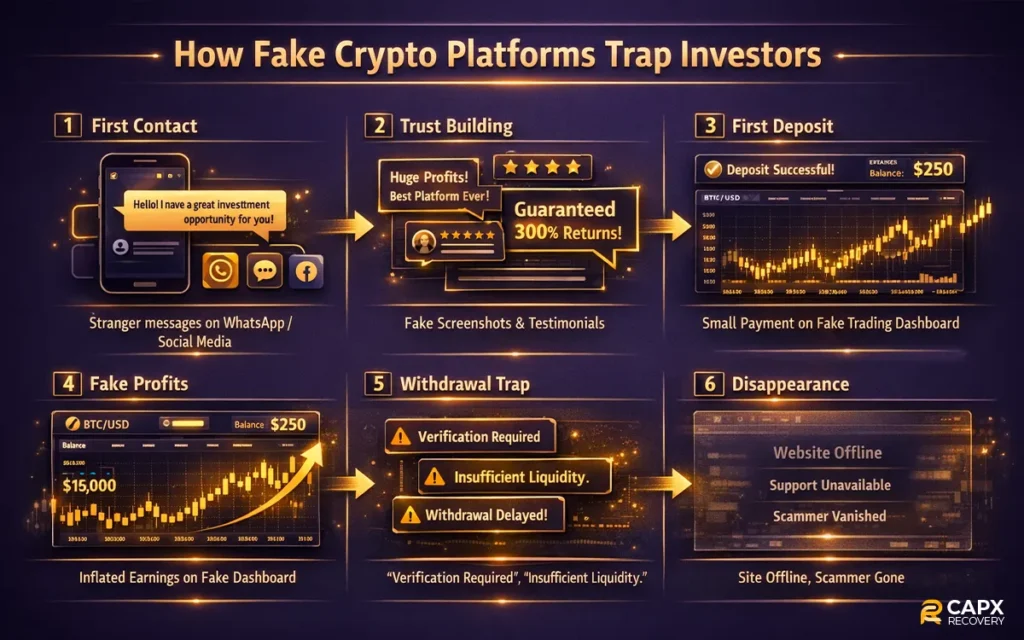
Fake platforms follow a repeatable system. It is simple, effective, and refined from thousands of past scams.
Most victims experience the same pattern, even if the story around it feels unique.
Step 1: The First Contact
It usually starts outside the platform.
Common entry points:
- Social media messages
- WhatsApp or Telegram groups
- Dating apps and “wrong number” texts
- Investment ads promising high returns
- Friends or influencers whose accounts were compromised
The goal is not to sell immediately. It is to start a conversation.
Step 2: Trust Building
Scammers pose as:
- Successful traders
- Financial mentors
- Friendly investors
- Or romantic interests
They share screenshots of profits, talk about their lifestyle, and act patient. Sometimes this phase lasts days or weeks.
You are slowly moved to their “recommended platform.”
Step 3: The First Deposit
You are asked to:
- Create an account on their platform
- Deposit a small amount of crypto
- Or send funds to a wallet address they provide
The platform shows instant profits.
Everything looks normal.
Step 4: Fake Profits and Encouragement
Your dashboard balance grows.
A “manager” praises your progress and suggests:
- Increasing your investment
- Unlocking VIP levels
- Paying to access better trading bots
Some victims reinvest profits that were never real to begin with.
Step 5: The Withdrawal Trap
When you try to withdraw, problems appear:
- Verification fees
- Tax charges
- Liquidity issues
- Account upgrades required
- “Suspicious activity” holds
Each obstacle requires more payment.
The withdrawals never arrive.
Step 6: The Disappearance
Eventually:
- Support stops replying
- The website goes offline
- Telegram groups vanish
- The contact blocks you
The money is already gone.
Common scam platform models
- Phishing platforms that steal login credentials
- Ponzi-style trading sites pay early users with new deposits
- AI bot trading scams claiming guaranteed automated profits
- Romance-investment hybrids where emotional trust drives bigger deposits
- Fake token exchanges are pushing worthless coins
Modern scams also use automation and AI to scale. Chatbots replace human “support agents.” Fake communities are filled with bots. Entire platforms can be launched in days.
Real-World Examples of Fake Crypto Platforms
These scams are not rare edge cases. They happen every day, across countries, age groups, and income levels.
Here are a few recent patterns that show how these platforms operate in the real world.
Fake trading platform promoted through WhatsApp groups
Victims were added to “crypto education” groups run by fake analysts. Daily screenshots showed huge profits. Members were encouraged to join a private trading website and start with small deposits. After weeks of apparent gains, withdrawals were blocked unless users paid “tax” and “liquidity” fees. The site disappeared shortly after most victims paid.
Romance + investment platform scam
Several cases involved scammers building relationships through dating apps, then introducing a “trusted” trading platform. Victims believed they were investing alongside their partner. Dashboards showed steady profits. When larger withdrawals were requested, accounts were frozen for “security reviews.” Funds were never released.
Clone exchanges impersonating popular brands
Scammers created near-identical copies of real exchanges using similar names and interfaces. Victims believed they were using a legitimate service after clicking ads or phishing links. Deposits went directly to scam wallets while the interface showed fake balances.
Across these cases, the structure stayed the same:
- Professional-looking platform
- Controlled fake profits
- Gradual pressure to deposit more
- Withdrawal blocked
- Platform vanishes
For many victims, the financial loss was severe. For some, it meant empty savings accounts, borrowed money, or long-term debt.
Red Flags to Spot Fake Crypto Platforms
Most fake platforms give themselves away. The problem is that the warning signs are easy to miss when emotions, money, or urgency are involved.
Here are the strongest red flags to watch for.
Platform-level red flags
- Promises of guaranteed or fixed returns
- Claims of zero risk
- No clear company registration or legal address
- Recently created domain names
- No listing on major crypto data sites
- Fake regulatory logos or license numbers
- Poor grammar in legal or support pages
- Only crypto deposits accepted, no fiat options
Behavior-based red flags
- Pressure to act quickly
- Being asked to keep the opportunity secret
- Requests for private keys or recovery phrases
- “Account managers” who insist you reinvest profits
- Being charged fees before withdrawals are allowed
- Support agents who avoid written confirmations
Technical red flags
- Withdrawal buttons that do nothing
- Wallet addresses that change often
- Profits that increase in perfectly smooth lines
- Trading activity that does not match real market prices
Quick safety checklist
Before investing in any platform:
- Search the platform name with the word “scam”
- Check the domain age using a WHOIS lookup
- Verify registration with financial regulators
- Look for real company directors or founders
- Compare prices with trusted exchanges
- Test withdrawals with a small amount first
If even one of these steps fails, walk away.
What to Do if You Suspect a Fake Crypto Platform?

If something feels off, act fast. The earlier you move, the better your chances of limiting damage and preserving useful evidence.
Step 1: Stop all Payments
Do not send more money.
Do not pay withdrawal fees, taxes, or “unlock” charges. These are almost always part of the scam.
Step 2: Secure Your Accounts
- Change passwords on your email, exchanges, and wallets
- Turn on two-factor authentication everywhere
- Move any remaining funds to a new wallet if possible
- Scan your device for malware or suspicious apps
Step 3: Collect Evidence
Save everything related to the platform:
- Website URLs
- Wallet addresses
- Transaction IDs (hashes)
- Screenshots of balances, errors, and chat conversations
- Emails or payment instructions
This information is critical if you decide to report the case or pursue recovery.
Step 4: Report the Scam
Depending on where you live, file a report with:
- Your local cybercrime unit or police
- The national cybercrime reporting portal
- Your financial regulator
- Any exchange that received or processed the transaction
You can follow a step-by-step breakdown of how to report crypto fraud and document your case properly in this guide.
Step 5: Track the Funds if Possible
Crypto transactions are public. You can:
- Look up the transaction on a blockchain explorer
- Note where the funds were sent
- Share that trail with authorities or exchanges
In some cases, this information helps freeze funds before they are fully laundered.
Step 6: Be Careful with Recovery Offers
After a scam, many victims are contacted by people claiming they can recover the money.
Be cautious of:
- Upfront “processing” or “legal” fees
- Guarantees of full recovery
- Messages that reference your loss without you contacting them first
If you are exploring professional help, look for services that clearly explain their process, risks, and limitations, such as dedicated cryptocurrency scam recovery specialists.
How to Avoid Fake Crypto Platforms in the Future?
Fake crypto investment platforms succeed because they feel real. They copy trusted brands, simulate profits, and exploit basic human instincts like hope, urgency, and trust. By the time most victims realize something is wrong, the money has already moved through multiple wallets.
The good news is that these scams follow patterns. Once you understand how they operate, the illusion breaks. Checking domains, verifying regulation, testing withdrawals, and ignoring guaranteed returns will filter out most fake platforms before any damage is done.
Crypto itself is not the enemy. Blind trust is.
Move slowly. Verify everything. Treat every new platform as untrusted until it proves otherwise. Those habits will protect you far better than any promise of fast profits.
FAQ
Are fake crypto platforms only found on unknown websites?
No. Many scams use professional websites, mobile apps, and even ads on popular social networks. Some platforms are clones of real exchanges with slightly different domain names, which makes them hard to spot at first glance.
Can I get my money back from a fake crypto platform?
Recovery is difficult but not always impossible. It depends on how quickly you act, where the funds are moved, and whether exchanges can freeze them. Reporting early and keeping transaction records improve the chances.
Why do fake platforms show profits before blocking withdrawals?
Those profits are fake numbers controlled by the scammers. They are designed to build trust and push victims to deposit more money before the platform locks withdrawals.
What should I do before investing in any new crypto platform?
Research the company, verify regulations, test a small withdrawal, compare prices with major exchanges, and never invest based on pressure or guaranteed returns. If anything feels rushed or secretive, walk away.

