
From the moment you step into the world of crypto, scammers are always one step ahead, watching, and ready to exploit your investments. The most dangerous nature of the scams is that they are unpredictable. The pitch sounds simple and believable. Your funds are visible, but you need to pay a small fee to unlock or process the withdrawal. Once the fee is paid, nothing moves. Instead, a new issue appears, and another fee is demanded. Many scams related to crypto wallets and withdrawals are happening out there.
This guide breaks down how crypto withdrawal fee scams work, the warning signs most victims miss, real-world examples, and what recovery options realistically exist after funds are sent.
What Is a Crypto Withdrawal Fee Scam?
A crypto withdrawal fee scam is a form of advance-fee fraud where victims are shown a fake crypto balance and told they must pay a fee before withdrawing their funds. The balance looks real. The platform looks functional. But the funds never existed or were never under the victim’s control.
The scam usually happens on fake exchanges, cloned trading websites, or through impersonated wallet support. After a user deposits crypto or believes they have earned profits, the withdrawal suddenly gets blocked. The reason sounds technical and urgent. Liquidity fee, network unlock, tax clearance, compliance verification, and gas fee upgrade.
Crypto Withdrawal Fee Scam: Step-by-Step
Scammers usually work in a particular pattern. If we understand this pattern we, we can easily protect ourselves. Following is a step by step explanation of how this scam takes place.
Step 1: The Attractive Investment Offer
The scam begins with a fake trading platform or broker promising high returns. The website looks professional and may include fake testimonials, live charts, and account managers.
Step 2: Initial Deposit
You are encouraged to deposit a small amount of cryptocurrency. Shortly after, your dashboard shows impressive profits to build confidence and trust.
Step 3: Encouragement to Invest More
Seeing apparent gains, you are persuaded to invest larger amounts. The scammer may maintain regular communication to strengthen credibility.
Step 4: Withdrawal Attempt
When you try to withdraw your profits, the platform blocks the request. You are told that a withdrawal fee, processing charge, or compliance cost must be paid first.
Step 5: Upfront “Fee” Payment
You are instructed to send additional cryptocurrency to cover the withdrawal fee. The scammer insists this payment cannot be deducted from your balance and must be paid separately.
Step 6: Additional Charges Appear
After paying the first fee, new charges are introduced such as tax clearance, anti-money laundering verification, gas fees, or account unlocking costs.
Step 7: Endless Delays and Excuses
Customer support redirects you to different “departments.” Each one demands more payments while delaying the withdrawal.
Step 8: Account Blocked
Eventually, communication stops, or your account is locked entirely. By this stage, you have lost both your initial investment and the additional “fees.”
Legitimate exchanges deduct withdrawal fees directly from your account balance; they do not require separate crypto transfers to release your funds.
Common Types of Withdrawal Fee Scams
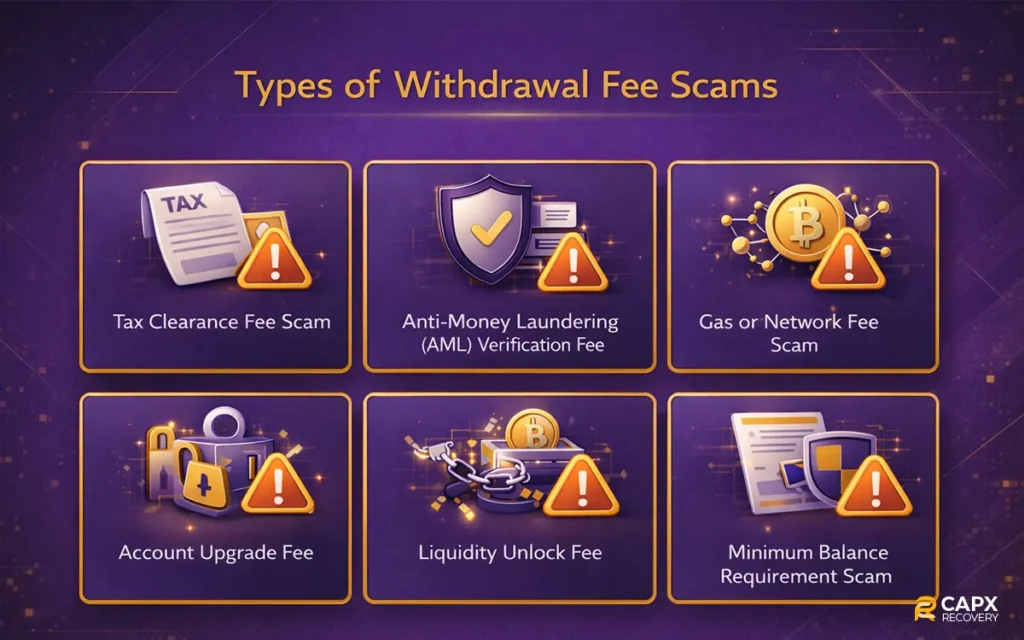
Withdrawal fee scams show up in several forms, but the structure stays the same. A visible balance, a blocked withdrawal, and a demand for upfront payment.
Tax Clearance Fee Scam
Victims are told they must pay a “withholding tax” or “government tax” before withdrawing profits. The platform claims this fee cannot be deducted from the balance and must be paid separately in crypto. After payment, withdrawals remain blocked.
Anti-Money Laundering (AML) Verification Fee
Scammers claim your account is flagged for AML compliance checks. To “verify” your identity, you are asked to send additional funds. Legitimate platforms do not require crypto transfers to complete compliance reviews.
Gas or Network Fee Scam
Fraudsters say network congestion requires extra gas fees to process the withdrawal. They insist you must send more cryptocurrency to speed up the transaction. In reality, network fees are automatically deducted from your balance.
Account Upgrade Fee
Victims are told they must upgrade to a premium or VIP account to unlock withdrawals. This often requires a significant deposit. Once paid, either new fees appear or the account is restricted again.
Liquidity Unlock Fee
The platform claims your funds are locked due to liquidity issues. To release them, you must provide an additional deposit as a “liquidity guarantee.” This is purely fabricated.
Minimum Balance Requirement Scam
Scammers state that withdrawals are only allowed if your account meets a certain minimum balance. Victims are pressured to deposit more funds to qualify. Even after meeting the requirement, withdrawals never happen.
Each version looks different on the surface, but the demand for an advance payment is the common red flag.
Real-Life Case Study: Crypto Withdrawal Fee Scam Via Social Media
According to Reddit, in late 2025, multiple victims reported being targeted through social media scam messages by individuals posing as crypto trading experts offering “guaranteed” returns and easy access to profits. In one widely shared account on Reddit from a user in India, the scam began with a WhatsApp message claiming to help with Bitcoin investments, backed by convincing screenshots and fabricated testimonials.
After an initial deposit, the scammers repeatedly demanded incremental payments labeled as “activation fees,” “withdrawal fees,” “tax fees,” and even “security deposits” before processing a withdrawal. Each time the victim paid, new excuses and additional fees were introduced, preventing any access to the funds. Ultimately, the victim lost $48,000 before realizing they had been manipulated and blocked. This pattern, initiated through a social chat and compounded with fake “fees” when trying to withdraw, is a hallmark of withdrawal fee scams spreading via social and messaging platforms.
Such schemes typically operate as social engineering scams, using staged trust and initial contact through social media or messaging apps to justify repeated requests for upfront crypto payments. Always verify platform legitimacy and avoid paying separate withdrawal or “tax” fees outside official exchange processes.
Early Warning Signs of a Crypto Withdrawal Fee Scam
Most victims realize something is wrong only after multiple payments. These warning signs usually appear much earlier. Read further to know the early waring signs of a crypto withdrawal fee scam in detail.
1. Separate “Upfront” Withdrawal Payments
Legitimate crypto exchanges automatically deduct transaction or network fees from your existing balance. They do not ask you to send additional crypto to a new wallet address to “release” your funds. If you are told to pay taxes, verification charges, unlocking fees, or clearance deposits before withdrawing, this is a major red flag.
2. Escalating Fee Demands
Scammers rarely stop at one payment. After you pay the first “fee,” they introduce another charge such as compliance fees, anti-money laundering clearance, international transfer fees, or account upgrades. This cycle continues until the victim stops paying.
3. Pressure and Urgency Tactics
Fraudsters create artificial deadlines. They may say your account will be frozen, profits will disappear, or legal action will begin if you do not pay immediately. Legitimate platforms do not pressure users into urgent payments outside normal system procedures.
4. Communication Outside Official Channels
If all communication happens through WhatsApp, Telegram, Instagram DMs, or private email instead of official customer support systems, caution is necessary. Telegram scams have become more common because scammers use the platform’s privacy and messaging features to trick people. Scammers prefer informal channels because they are harder to trace and easier to abandon.
5. Unrealistic Profits Displayed on Fake Dashboards
Many scams use professional-looking websites or apps showing large profits to build trust. These dashboards are often manipulated. Seeing high returns does not mean real funds exist.
6. Poor Transparency and Missing Regulatory Details
Fake platforms often lack verifiable registration information, clear company addresses, or recognized regulatory oversight. Documents provided may look official, but cannot be independently confirmed.
7. Requests for Additional Deposits to “Qualify” for Withdrawal
A legitimate investment does not require you to deposit more money just to withdraw your own funds. Any platform demanding additional investment before the release of funds is highly suspicious.
8. Being Passed Between Multiple “Departments.”
Victims are often transferred between fake support agents, finance teams, tax departments, or compliance officers. This staged structure is designed to appear professional while extracting more payments.
One red flag alone should trigger caution. Multiple red flags almost always confirm a withdrawal fee scam.
Withdrawal Fee Scam vs Legitimate Crypto Fees
One reason these scams work is that real crypto transactions do involve fees. The difference is how those fees are charged and who controls them.
| Feature | Legitimate Crypto Fees | Withdrawal Fee Scam |
| Who charges the fee | Blockchain network or verified exchange | Scammer posing as a platform |
| How the fee is applied | Automatically deducted from the balance | Paid separately upfront |
| Transparency | Public fee schedule or network data | Vague, changing explanations |
| Payment destination | Platform system or network | Personal wallet address |
| Result after payment | Withdrawal completes | New fees are demanded |
Legitimate exchanges never ask users to send money outside the platform to unlock withdrawals. If a platform claims your funds exist but cannot deduct fees directly, the funds are not real or are not under your control.
How to Avoid a Crypto Withdrawal Fee Scam
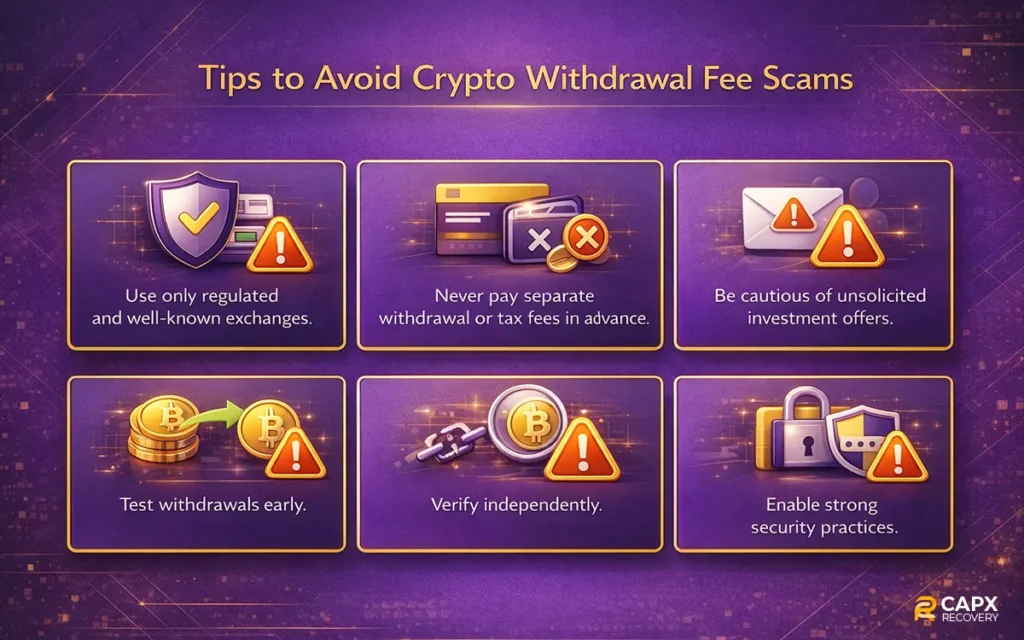
Avoiding a withdrawal fee scam starts with understanding how legitimate platforms operate and refusing to act under pressure.
Use only regulated and well-known exchanges.
Before investing, verify the platform’s registration, official website domain, and customer support channels. Avoid platforms introduced through random social media messages.
Never pay separate withdrawal or tax fees in advance.
Real exchanges deduct fees automatically from your account balance. They do not ask you to send extra crypto to unlock withdrawals.
Be cautious of unsolicited investment offers.
If someone contacts you on WhatsApp, Telegram, Instagram, or Facebook promising guaranteed profits, treat it as high risk.
Test withdrawals early.
If you try a new platform, deposit a small amount and attempt a withdrawal before investing more. Difficulty withdrawing small funds is a serious warning sign.
Verify independently.
Search for company reviews, regulatory records, and scam alerts outside the platform’s own website or testimonials.
Enable strong security practices.
Use hardware wallets for long-term storage, activate two-factor authentication (2FA), and never share private keys or seed phrases.
Most importantly, slow down. Scammers succeed by creating urgency and emotional pressure. Taking time to verify details can prevent significant financial loss.
What to Do If You’ve Been Scammed
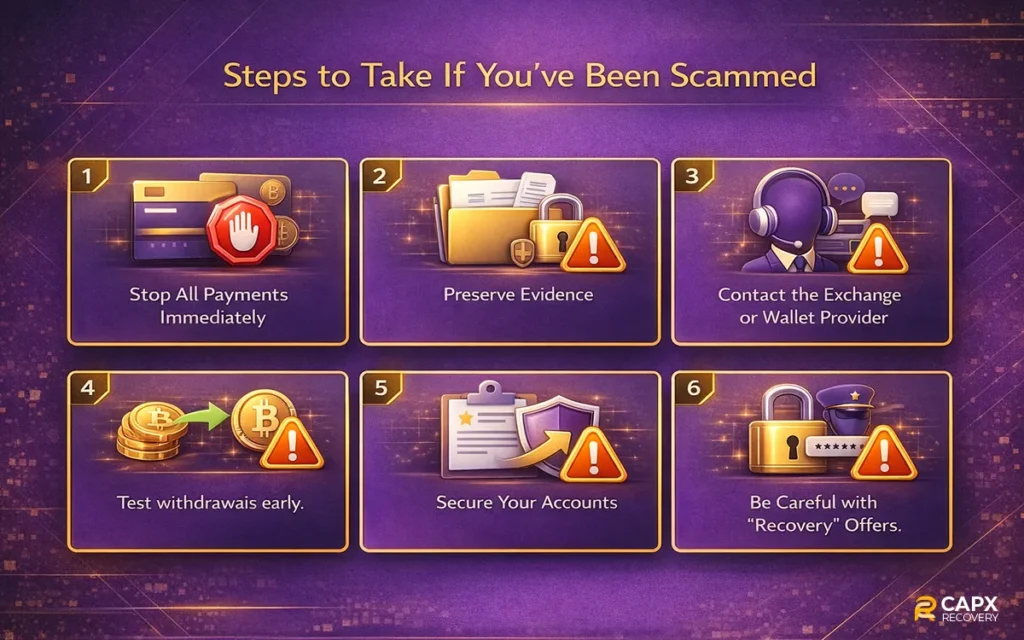
If you realize you’ve fallen victim to a crypto withdrawal fee scam, act quickly and stay calm. Immediate action can sometimes limit further damage.
1. Stop All Payments Immediately
Do not send any additional “fees,” even if promised full recovery after one last payment. Scammers often escalate demands once they sense hesitation.
2. Preserve Evidence
Save wallet addresses, transaction IDs (TXIDs), screenshots, emails, chat logs, website links, and payment confirmations. Record dates, amounts, and all communication details.
3. Contact the Exchange or Wallet Provider
If you transferred funds from a legitimate exchange, notify their support team immediately. In some cases, they may flag suspicious wallet addresses or assist with internal investigations.
4. Report to Authorities
File a complaint with your national cybercrime unit or financial crime authority. In the U.S., this includes the FTC or FBI IC3. In India, report through the Cyber Crime Portal. Official reports create documentation that may help investigations.
5. Secure Your Accounts
Change passwords, enable two-factor authentication (2FA), revoke wallet permissions, and scan your devices for malware.
6. Be Careful with “Recovery” Offers
After a scam, victims are often targeted again by fake recovery agents. Avoid anyone who guarantees recovery or demands large upfront fees. Choose a legitimate withdrawal scam recovery service wisely. One such firm is Capx Recovery.
While crypto transactions are difficult to reverse, acting fast improves the chances of tracing funds and preventing further loss.
You’re Not Alone, Take the Next Step Forward
Falling victim to a crypto scam can feel overwhelming, frustrating, and even embarrassing. Many people blame themselves, but the truth is these scams are carefully engineered to manipulate trust and urgency. They are designed to look real, professional, and convincing. What matters now is not what happened but what you choose to do next.
Acting quickly, preserving evidence, and seeking the right support can make a meaningful difference. Recovery may not always be instant, but the right expertise can help trace transactions, document fraud, and explore possible recovery pathways.For guidance with professional cryptocurrency fraud assistance, with blockchain tracing expertise, and structured recovery support, contact us today at Capx Recovery.
Frequently Asked Questions
Why can’t the fee be deducted from my balance?
If a platform claims it cannot deduct fees from available funds, the balance is likely fake or not under your control.
Can blockchain transactions be reversed?
No. Blockchain transactions are irreversible by design. Recovery focuses on freezing accounts or tracing funds, not reversing payments.
How long does crypto scam recovery take if it works?
When recovery is possible, it often takes months, not days. Fast recovery promises are a major red flag.
Why do scammers ask for multiple fees?
Each fee is designed to extract more money once trust and hope are established. There is always another issue after the first payment.