There are more scammers online than genuine businesses. The Internet offers several business opportunities, but many of them are scams. Scammers frequently steal money from their victims through fraudulent activities, including levying illegal taxes.
Impersonating online brokers, these fraudsters offer fake services such as stock, commodity, forex, binary options, and crypto trading, often as part of a crypto investment scam, while charging bogus brokerage and withdrawal taxes.
The only thing that will protect you against these scams is staying informed. Continue reading this blog to know how these tax scams occur, how to identify them, and how to stay protected in the long run.
How a Crypto Tax Scam Takes Place?
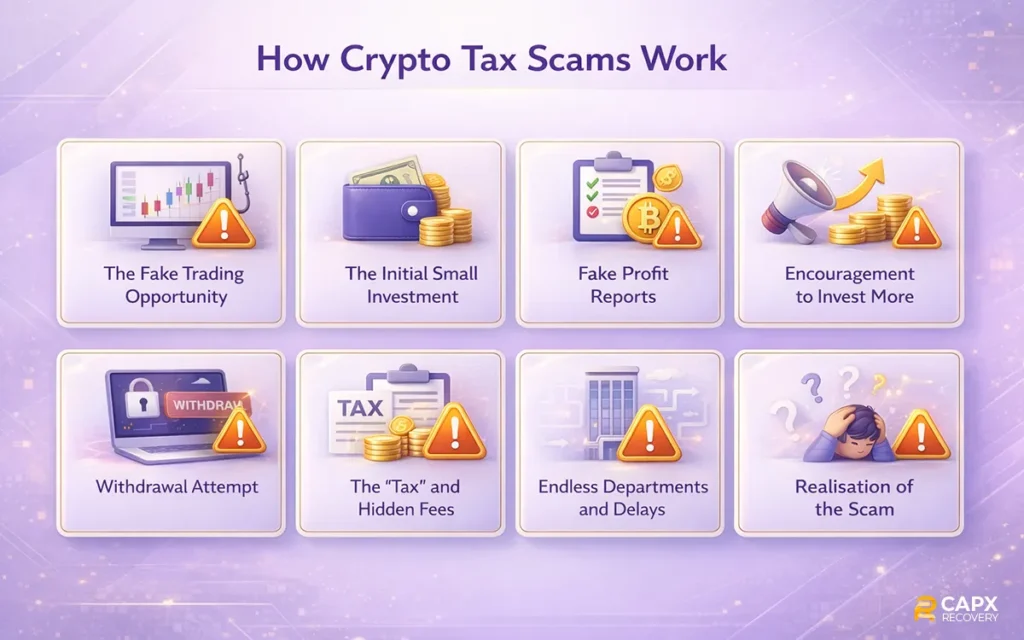
Here’s a stepwise explanation of how this scam occurs.
Step 1: The Fake Trading Opportunity
The scheme begins with a legitimate-looking trading platform that promises access to crypto and financial markets. Victims are offered high returns, expertise, or automated trading platforms. The site looks legitimate, often displaying live charts and dashboards.
Step 2: The Initial Small Investment
Victims are encouraged to deposit a small amount first. The platform may even allow limited interaction to build trust. Shortly after, the account dashboard begins showing impressive returns.
Step 3: Fake Profit Reports
The scammer provides fabricated performance reports showing large gains. Victims see their balance growing rapidly, which creates excitement and confidence. This psychological tactic pushes them to invest larger amounts.
Step 4: Encouragement to Invest More
After seeing fake profits, victims are persuaded to deposit more money to “maximize returns.” Scammers may assign a fake account manager to maintain regular contact and build trust.
Step 5: Withdrawal Attempt
When the victim decides to withdraw funds, the platform suddenly introduces a problem. They are told that taxes, compliance charges, or verification fees must be paid before the withdrawal can be processed.
Step 6: The “Tax” and Hidden Fees
Victims are instructed to pay crypto “taxes,” gas fees, anti-money laundering charges, or unlocking fees. These payments must be made separately and up front. The amounts often increase over time.
Step 7: Endless Departments and Delays
After paying, victims are redirected to different “departments” such as compliance, risk control, or tax processing. Each department demands additional fees. Withdrawals are repeatedly delayed with new excuses.
Step 8: Realization of the Scam
Eventually, communication stops, or the platform blocks access entirely. By this stage, victims have paid multiple fees and lost their entire investment.
Crypto Tax Scam is very hard to recognise and consumes your investments. Here is a real-life incident and the recent data that denote the severity of this incident.
Real Life Incident and Recent Data
In late 2025 and early 2026, a joint task force consisting of the U.S. The Department of Justice, Federal Bureau of Investigation, and other law enforcement entities launched a series of enforcement actions against large-scale cryptocurrency fraud schemes targeting American victims through fake crypto investment schemes and confidence schemes. The U.S. authorities froze and seized more than $580 million in stolen cryptocurrency from scam operations allegedly controlled by international criminal organisations that lured American victims into fake crypto investment schemes and fake crypto trading schemes via social media and messaging before scamming their money. The law enforcement authorities seized scam domains used by these international criminal organizations to scam hundreds of thousands of Americans and continue their efforts in returning stolen funds to victims and disrupting these international criminal schemes.
This is a prime example of how crypto scams can be highly sophisticated, including schemes of manipulated trust and fake investment websites, and how authorities in the U.S. are actively working against these schemes.
Recent Statistics:
Tax scams remain one of the biggest financial hazards in the United States. These include cryptocurrency-based scams. It was reported in 2025 that nearly 23% of people in the United States claimed to know either themselves or someone else who had fallen victim to a tax scam.
The average loss for the victim is said to be around $8,400. Additionally, the Internal Revenue Service reported over 600 social media impersonation accounts related to tax fraud activity during the fiscal year. It is also important to note that the overall crypto fraud loss reported by the FBI is in the billions annually.
6 Common Crypto Tax Scams in Online Trading
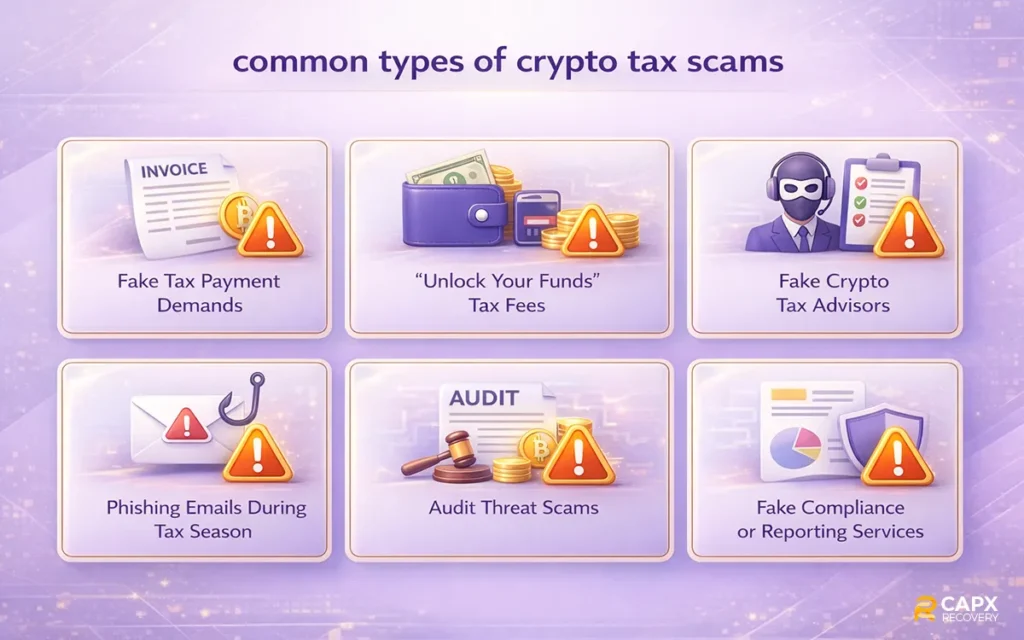
These are the common types of crypto tax scam that you need to be aware of.
Fake Tax Payment Demands
The scammers pretend to be tax authorities and notify the victim about unpaid crypto taxes or penalties. The scammers threaten the victim with fines, audits, or lawsuits. The scammers ask the victim to immediately send cryptocurrency to avoid the penalties. Tax authorities never ask for payments in cryptocurrency to random addresses or messages.
“Unlock Your Funds” Tax Fees
Fraudulent trading platforms claim your profits cannot be withdrawn due to pending tax obligations. You are asked to pay a so-called tax clearance or processing fee upfront. Once the payment is made, the platform either blocks you or disappears entirely. Real exchanges deduct fees directly and do not require separate crypto tax transfers.
Fake Crypto Tax Advisors
Scammers pose as professional tax consultants offering to reduce your crypto tax burden. They may request wallet access, private keys, or advance payments for “filing services.” After receiving funds or sensitive data, they cut off communication. Always verify credentials and avoid sharing confidential wallet information.
Phishing Emails During Tax Season
Fraudulent emails claiming to be from exchanges or tax authorities ask you to verify your transaction records. The email directs you to a fake login page via a link. After gaining access, they drain your funds or exchange account. Be cautious and verify website addresses when entering your login credentials.
Audit Threat Scams
Victims receive calls or messages claiming they are under investigation for crypto tax evasion. The scammer pressures them to settle immediately using cryptocurrency. Fear and urgency are used to prevent independent verification. Official tax agencies do not demand instant crypto payments over the phone or text.
Fake Compliance or Reporting Services
Some websites claim to generate automated crypto tax reports but are designed to harvest wallet data. They may charge hidden fees or request unnecessary permissions. In some cases, they use uploaded transaction history to target victims further. Always research tax software providers before sharing financial data. After understanding these types, we can move towards how to avoid such a scam.
How to Avoid a Crypto Tax Scam
Now, let us learn several things to do in order to avoid a crypto tax scam.
- Verify the Platform First
It is important to research the trading platform before investing. If the trading platform is new, avoid it. Also, the company’s information must be available.
- Be Skeptical of Unrealistic Profits
High, guaranteed, or consistent returns are major warning signs. Legitimate trading involves market risk and volatility. Fake dashboards can easily display fabricated profits.
- Never Pay Upfront “Tax” or Withdrawal Fees
Real exchanges deduct trading fees directly from your balance. They do not ask you to send additional cryptocurrency to unlock funds or pay taxes separately.
- Confirm Tax Claims Independently
If you receive a message saying you have crypto taxes to pay, check your country’s tax department website. Do not click on links sent via email, WhatsApp, Telegram, or social media.
- Avoid Sharing Private Information
Never share your private keys, seed phrase, or wallet credentials. No legitimate tax authority or exchange will ask for them.
- Use Secure Storage Practices
Keep long-term savings in a hardware wallet and enable 2FA on all accounts. Strong passwords can help prevent unauthorized access.
- Pause Before Sending Money
Scammers thrive on the sense of urgency and fear. So, if you feel pressured to act immediately, take a step back and verify everything before making any payment.
By following these ideas, one can ensure their safety from the scam.
What to Do If You’ve Been Scammed?
Even after practising all the precautionary measures, in case you feel that you have been scammed, these are the steps you should follow immediately.
Stop All Payments Immediately
Do not send any more money, especially “recovery,” “tax,” or “unlock” fees. Cut communication with the scammer right away.
Secure Your Accounts
Change your passwords for your email, exchange accounts, and banking apps. Enable 2FA. Revoke your wallet permissions and transfer your remaining balances to a secure hardware wallet, if possible.
Collect and Preserve Evidence
Save wallet addresses, transaction IDs (TXIDs), screenshots, emails, chat logs, and payment receipts. Record dates, amounts, and platform URLs. This documentation is essential for reporting.
Notify the Exchange and Bank
If an exchange was involved, report the wallet addresses and provide full evidence immediately; early reporting may help freeze funds. Contact your bank or card provider to request chargebacks or transaction recalls if applicable.
Report to Authorities
File a complaint with your national cybercrime unit or financial fraud authority. In the U.S., victims can report to the FBI’s IC3 portal. Official reports improve tracking and potential asset recovery efforts.
Contact Recovery firms
If your funds were stolen, consider reaching out to a reputable crypto recovery firm that specializes in blockchain forensics and asset tracing. Always verify credentials carefully and avoid any service that guarantees recovery or demands large upfront fees. Connect with legitimate recovery service providers like CapX Recovery.
Act Quickly
Time is critical. The sooner you report and secure your accounts, the better your chances of limiting further losses.
By taking these precautions, you can protect yourself from tax fraud and other online scams in the world of trading.
You Are Not Alone, Take Back Control
It can be frustrating, overwhelming, and even embarrassing to fall victim to a crypto scam. However, it is essential to note that these scams are very sophisticated. Anyone can fall victim to these scams.
What is essential at this stage is not the fact that you have made a mistake, but what you do next. What you do next can help you recover from the situation. Most importantly, however, do not blame yourself. Instead, learn from your experience and move on. Recovery from such a situation starts with your awareness of the fact that you are already doing that.Don’t face it alone; take a confident step forward and contact us to connect with the experts at Capx Recovery today.
FAQs
How do scammers execute tax fraud?
Scammers typically operate through fake trading platforms or impersonation tactics. After showing fabricated profits, they claim taxes must be paid before withdrawals can be processed. They may also pose as tax officials, sending threatening emails or messages demanding immediate crypto payments to avoid penalties or legal action.
What are common types of tax fraud scams?
Common schemes include fake tax payment demands, withdrawal “tax clearance” fees, impersonation of government tax agencies, phishing emails during tax season, and fraudulent tax advisory services. Many of these scams use urgency and fear to prevent victims from verifying the information independently.
How can I avoid falling victim to tax fraud?
Verify all tax-related claims directly through official government websites. Never send cryptocurrency as a tax payment to a private wallet address. Be cautious of platforms that require separate tax payments before withdrawals, and avoid clicking suspicious links in unsolicited emails or messages.
What should I do if I suspect tax fraud?
Stop all payments immediately and secure your accounts. Gather evidence such as transaction IDs, wallet addresses, and communication records. Report the incident to your local cybercrime authority and notify any exchange or bank involved as soon as possible.