The arrival of cryptocurrency transformed investment activities, but also brought along scams. Scammers take advantage of the decentralized nature of the blockchain to scam new investors. In 2025 alone, cryptocurrency scams reaped billions of dollars in global losses, with social engineering and increasing fake exchanges.
The greatest protection is awareness. Being aware of risks, knowing some of the ways that scammers operate, and being informed on how to stay safe will help prevent a loss from becoming a big loss. This book is written as a resource to help investors recognize, report, and protect themselves from cryptocurrency scams.
What Is a Cryptocurrency Scam?
Cryptocurrency scams are illegal acts that deceive investors into investing in illegal schemes, wallets, or exchange platforms. Cyber criminals take advantage of the transparent and anonymous nature of the technology used in cryptocurrencies, which they manipulate by altering transactions, making them difficult to trace.
While regular financial scams depend on greed, crypto scams are powered by excitement, misdirection, and sheer manipulation on a psychological level. Most include unrealistic profit promises, celebrity or exchange impersonations, and pseudo-tokens or apps. Knowledge of how these work constitutes prevention itself.
The scammers often reach investors through social media, fake websites, spam messages, or dubious investment offers. They achieve their goal if they manage to create a sense of urgency, faith, and fear of missing out.
Top 10 Most Common Cryptocurrency Scams
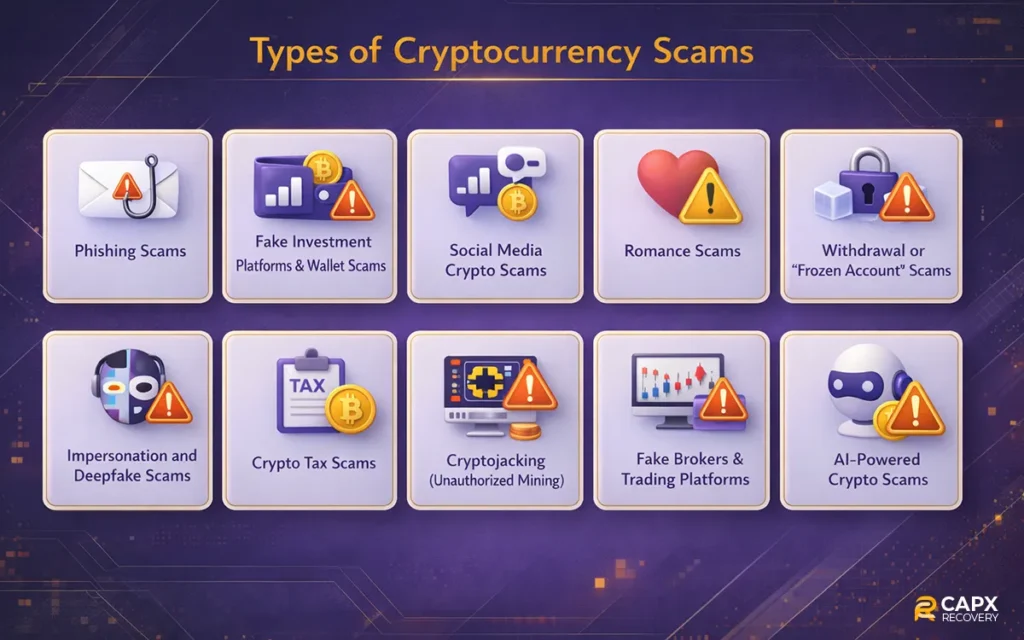
Cryptocurrency scams can take many different forms, but all follow the same pattern: to attract and lure the victim with the promise of higher gains and then abscond with the money once transferred. It is important to know the common forms of these scams to ensure one’s safety.
1. Phishing Scams (Email/SMS Crypto Scams)
Phishing scams are messages sent to the victim in the form of emails or messages claiming to be from authentic cryptocurrency sources, which can trick them into divulging their private keys, passwords, or login credentials. This can allow the scammers to access the account and drain the funds.
Recent Trends:
In 2025, phishing and impersonation-based scams enabled scammers to steal an estimated $17 billion worth of Bitcoin globally, with average payouts rising sharply.
2. Fake Investment Platforms & Wallet Scams
These scams set up professional-looking investment sites or wallet apps that promise high returns. Victims deposit funds thinking they’re investing or storing crypto, but the platform is fake, investors can’t withdraw, and all funds vanish.
Recent Trends:
Indian cybercrime police dismantled a fake crypto investment racket that defrauded investors of nearly ₹100 crore by promising huge referral-based returns.
3. Social Media Crypto Scams
These scammers may use social media as a way of advertising fake giveaways, impersonating social media influencers, or offering fake investment deals. The victims clicking on these links and transferring cryptocurrency are easily duped.
Recent Trends:
Research has shown that hundreds of millions of dollars have been lost due to these social media scams, including AI deepfakes.
4. Romance & “Pig Butchering” Scams
Scammers establish emotional trust through dating apps or chat, after which they convince their victims to send their cryptocurrencies for investment or in times of emergency. After receiving their victims’ money, they disappear.
Recent Trends:
Romance scams have resulted in over $1 billion in losses for victims in recent reports, while pig butchering scams are on the increase in 2025.
5. Withdrawal or “Frozen Account” Scams
After victims deposit funds or buy crypto, scammers claim the account is “frozen” due to regulatory checks or tax fees, demanding extra payments to unlock funds. Until extra payments are made, withdrawals remain impossible.
Recent Trends:
This tactic appears in many fake brokers and fake investment schemes, with victims reporting increasing losses when scammers claim extra “tax” or “verification” fees.
6. Impersonation and Deepfake Scams
Here, scammers pretend to be a public figure, an executive in a company, or even a government agency, and they use fake accounts or deepfake technology to promote fake crypto investment schemes. This is used to trick the victim into sending money.
Recent Trends:
The use of AI in impersonation scams exploded in 2025, and one report showed a 1,400% rise in impersonation scams, with deepfake videos being used to trick victims.
7. Crypto Tax Scams
Here, scammers contact the victim and claim that they owe money in taxes in crypto or face penalties. The scammers then ask them to send money in crypto, which goes directly to the scammers’ accounts.
Recent Trends:
Crypto tax scams have been noted to be used in social engineering scams, especially when the scammers pretend to be government agencies.
8. Cryptojacking (Unauthorized Mining)
Cryptojacking is a form of attack wherein your device, i.e., computer/mobile, gets infected by malware, and it starts mining cryptocurrency for the attacker, but there is no reward for the victim.
Recent Trends:
Cryptojacking is a growing trend, especially for users who have not protected their devices, and the extent of loss is based on whether it is detected or not.
9. Fake Brokers & Trading Platforms
Fake brokers often claim to trade or manage your crypto for profit, showing fake dashboards with growing balances while restricting withdrawals or disappearing once enough funds are collected, a pattern commonly seen in withdrawal fee scams and fake broker schemes.
Recent Trends:
Scam platforms in 2025 used “system errors” and fake fees to trap victims into non-withdrawable balances before draining investments.
10. AI-Powered Crypto Scams
These use AI tools such as deep fake videos, chatbots, and fake trading bots to improve the realism of the scams. Scammers will use these tools to develop realistic investment pitches and fake profits.
Recent Trends:
There has been an exponential rise in AI-based scams. A report showed a rise of 456% in such scams between May 2024 and April 2025. This is making such scams difficult to trace.
Learning about these scams will prove beneficial in the long run.
How to Spot Crypto Scams: Red Flags Every Investor Should Know
The best defense is early detection, and most crypto scams follow a predictable pattern. If you know what to look for, you can avoid serious damage to your finances. Below is a detailed breakdown of the most common and most overlooked signs of a scam:
Unrealistic or Guaranteed Returns
The promise of fixed daily returns, doubling your investment in a matter of weeks, or “risk-free” crypto investments is a significant warning sign. Crypto investments are highly volatile by nature. No legitimate investment can guarantee high returns on investment (ROI) every day. Scammers use fake investment dashboards to show fake investment returns and create a false sense of security before locking users out of their accounts.
Anonymous, Fake, or Unverified Team Members
Legitimate projects have transparent teams consisting of founders, developers, and sometimes advisors. These people should have verified profiles on LinkedIn and should have given interviews about their projects. Scam projects have fake team members with fake profiles and sometimes fake faces too. Sometimes scammers may impersonate real people without their permission.
Plagiarized, Vague, or Missing Whitepaper
A legitimate project has a whitepaper that clearly describes how their project works, what problem they are solving, and how they are planning to make money in the future. A scam project may have a whitepaper that is copied from another project, may be written in a confusing manner, or may have buzzwords but lack substance in terms of the technology used. Sometimes scam projects may not have a whitepaper at all.
Pushy Sales Tactics & Artificial Urgency
Scammers create pressure using countdown timers, “limited allocation,” or “exclusive early access. They may contact you repeatedly and discourage independent research. Fear of missing out (FOMO) is a common psychological tactic.
Suspicious Website or Domain
The website’s domain should also be checked. Scammers often misspell the website’s domain, for instance, binànce.com instead of binance.com. Scammers also do not have a secure connection, such as HTTPS or a new domain registration. Grammar and design quality are also good indicators of a scam website.
Fake Partnerships or Celebrity Endorsements
Fake partnerships with popular companies, such as the use of company logos, are also a trick that scammers use to deceive victims. Deepfake videos of popular celebrities are also used by scammers to promote fake crypto giveaways.
No Independent Audit or Community Transparency
A legitimate Real DeFi project will undergo a third-party audit on its contracts. A legitimate crypto project will have its own community on Discord, Telegram, or X (Twitter). Scams also have their own community, but they disable comments, hide criticism, and even have fake interactions.
Withdrawal Restrictions or Hidden Fees
Most scams allow deposits, but when you want to withdraw, they restrict you. Scams also charge you “tax,” “gas,” “verification,” “unlock,” etc., before you withdraw. Real crypto projects deduct fees directly from your balance, not ask you to deposit more money.
Unsolicited Investment Offers
The appearance of unsolicited messages on WhatsApp, Telegram, Instagram, or LinkedIn concerning trading bots or secret investment strategies should be a point of concern. Professional financial institutions never send unsolicited messages to strangers on matters concerning investment strategies.
Fake Apps or Wallet Clones
Cyber criminals post fake apps for wallets that resemble the original apps. After entering your seed phrase or private keys, your money will be immediately drained.
Lack of Regulatory Information
If the company claims to have a license, verify it with the relevant financial authority. Scammers provide fake registration numbers or reference other companies.
No Clear Business Model
A genuine crypto project should have a clear explanation of its revenue model. The company might make money from transaction fees, software sales, staking, or a product. If the company only makes money by recruiting more people instead of creating value, then it might be a Ponzi scheme.
Identification of these red flags will help you take your first step toward protecting yourself from crypto scams.
How to Protect Yourself from Cryptocurrency Scams?
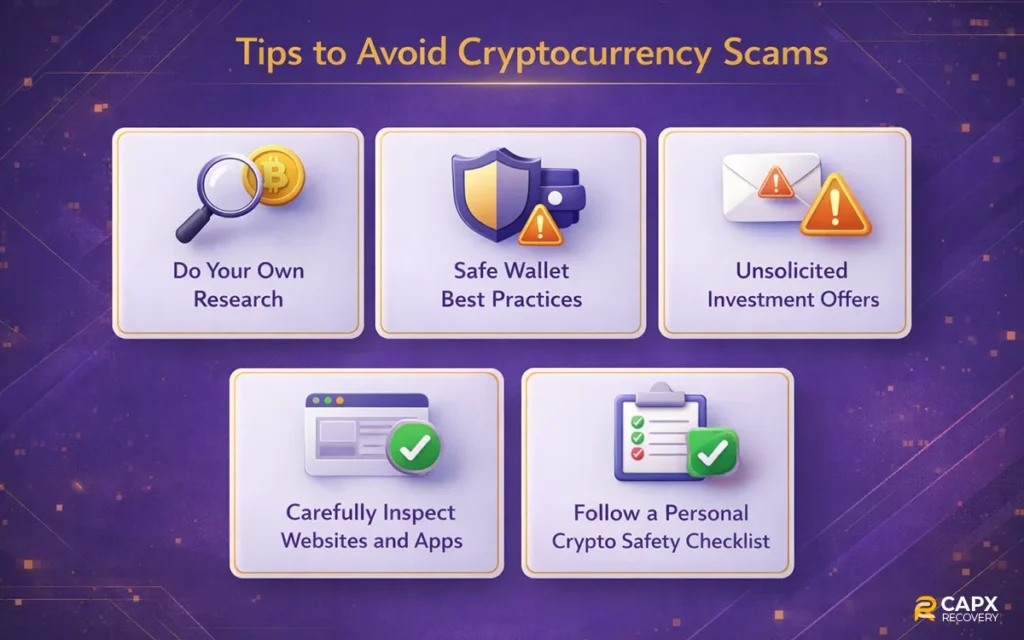
Prevention of crypto scams starts with care and thorough security practices. Employ the following processes to protect your investments:
Do Your Own Research
Investors are advised to take some time to research the project team, white paper, and third-party audit reports before investing in a project. Investors should also ensure that they are following the project team’s official social media accounts and community channels, as fake social media accounts are created for fake projects.
Safe Wallet Best Practices
For long-term cryptocurrency holdings, investors should use a hardware (cold) wallet to keep assets offline and protected from online threats. It is also wise not to store all funds on a single exchange, as platforms can be hacked or face operational issues. Enabling two-factor authentication (2FA) adds an extra layer of account security, and using strong, unique passwords for every platform significantly reduces the risk of unauthorized access.
Unsolicited Investment Offers
It is recommended that an investor be cautious about strangers who send them investment opportunities in cryptocurrency. It is also recommended that an investor not respond to investment opportunities through emails, WhatsApp, Telegram, or DM about guaranteed profits. Financial services do not solicit individuals for investment opportunities.
Carefully Inspect Websites and Apps
Only download wallet apps through official app store channels or project websites. Verify URLs for any misspellings or unusual domain suffixes. Be cautious of HTTPS connections and avoid opening links sent by unknown parties.
Follow a Personal Crypto Safety Checklist
Store your private keys and seed phrases completely offline, never sharing them. Review and remove any unused wallet app permissions. Verify token contracts and authenticity before buying, especially in decentralized exchanges.
By combining research, secure storage, and cautious behavior, investors can significantly reduce the likelihood of being crypto scam victims.
How and Where to Report Cryptocurrency Scams?
In case one suspects they are being scammed or if they feel they have been scammed, immediate action can be taken to stop the scam and recover the money.
1. Government Agencies
In the United States, the government agencies to contact in case of crypto scams include:
FTC (Federal Trade Commission) – consumer protection and reporting scams.
FBI IC3 – Internet Crime Complaint Center to report cybercrime scams.
SEC (Securities Exchange Commission) – to report scam investment schemes.
CFTC (Commodity Futures Trading Commission) – to report scams on derivatives and commodities.
International investors should contact the cybercrime unit of their local area.
2. Crypto Exchanges and Banks
In case of being scammed, the best solution is to notify the crypto exchange and bank right away and provide them with all the information regarding the scam, such as the wallet addresses and TX IDs, screenshots, and timestamps. An official complaint should also be filed with the cybercrime department to strengthen the case. The accounts should be secured right away
3. Recovery and Investigation Resources
Forensic crypto professional services can trace stolen funds and provide evidence to law enforcement or exchanges.
Learn more about cryptocurrency scam investigations and how experts handle these cases at CapX Recovery.
Reporting promptly not only safeguards you but also alerts authorities and platforms, preventing others from getting involved.
What to Do Immediately After a Crypto Scam
If you spot a crypto scam, while it may come as a shock, the sooner you act, the higher your chance of recovery.
Halt All Transactions
Stop making transactions right away. This includes disconnecting any linked wallets, revoking any smart contract permissions, and detaching any suspicious applications. Do not pay any so-called “recovery fees” or any other fees, as this will simply result in further loss.
Gather and Preserve Evidence
This includes wallet addresses, transaction ID, screenshots, emails, chat logs, and any other platform links. Documentation is key in this step, as this will help in building a strong case.
Report the Incident Immediately
You can report this incident to authorities such as the FTC, FBI, Internet Crime Complaint Center, SEC, or your local cybercrime cell. You can also report this incident to exchanges such as Binance, Coinbase, or Kraken with full evidence attached so they can flag or freeze any accounts associated with this incident.
Be Cautious with Recovery Services
Legitimate blockchain forensic companies can recover your stolen assets. However, some of these services promise full recovery in exchange for payment in advance. Most of these services are follow-up scams. Thus, it is essential to seek professional help from reputable companies.
Secure All Related Accounts
Change your passwords immediately. Enable two-factor authentication for your email, exchange, and bank accounts. Transfer your other assets to a secure cold wallet. Check your related apps for unnecessary permissions.
Educate and Inform Others
Report your case to some reliable platforms or forums. Spreading awareness can help protect more victims from such scams. It can also hinder the operation of these fraud networks.
By working systematically, documenting your evidence, and utilizing legitimate authorities, you can recover more of your stolen cryptocurrency.
A Real-Life Example of a Cryptocurrency Scam
Regulators in the US (FBI) took stronger measures in 2025 against crypto pig butchering investment scams targeting American victims on social media and messaging apps. Billions of dollars in crypto investment scams were reported by the Federal Bureau of Investigation (FBI) and Internet Crime Complaint Center (IC3) in the US.
Investment scams involved crypto “pig butchering” schemes in which scammers developed online relationships with victims and introduced them to fake crypto investment apps. They then showed fake investment returns in hopes of luring more investment from victims. After victims attempted to make withdrawals, they were asked to pay more “tax” or “verification” fees before communication ceased and the money vanished.
The US authorities collaborated with blockchain forensic companies and international partners in tracing and freezing crypto exchange-linked accounts; however, recovering funds is difficult once they have been transferred across several accounts.
Living Securely in the World of Cryptocurrency
Living securely in the world of cryptocurrency requires constant awareness, patience, and discipline. Scammers evolve quickly, but their tactics often follow predictable patterns: urgency, secrecy, and unrealistic promises. Investors who take time to research projects, verify teams and audits, use secure storage methods, and report suspicious activity early significantly reduce their risk exposure.
Crypto security is not a one-time action. It is an ongoing habit of verifying, protecting, and staying informed. When you combine knowledge with proactive safety measures, you turn vulnerability into control.
If you or someone you know has been affected by a cryptocurrency scam, professional assistance can improve the chances of tracing and potentially recovering lost assets. Contact us at Capx Recovery for experienced guidance, structured investigation processes, and reliable support to help victims navigate crypto fraud recovery safely and efficiently.
Frequently Asked Questions
Is every crypto investment risky?
All investments carry some level of risk, and cryptocurrency is especially volatile. The risk increases significantly when projects lack transparency, audits, or a clear business model. Careful research and secure storage practices help reduce but not eliminate risk.
How do I vet a crypto project?
Start by verifying the team’s background and checking for real, traceable identities. Read the whitepaper carefully and confirm independent smart contract audits. Review community engagement, GitHub activity, token distribution, and official announcements before investing.
What is the best way to keep crypto safe?
Use a hardware (cold) wallet for long-term storage and enable two-factor authentication on all accounts. Never share your private key or seed phrase, and regularly review wallet permissions. Strong, unique passwords and phishing awareness are essential.
What is the latest trend in crypto scams?
Recent trends include AI-powered impersonation scams, deepfake celebrity endorsements, fake trading apps, and “pig butchering” investment schemes. Scammers increasingly use social media and messaging apps to build trust before directing victims to fraudulent crypto platforms.