
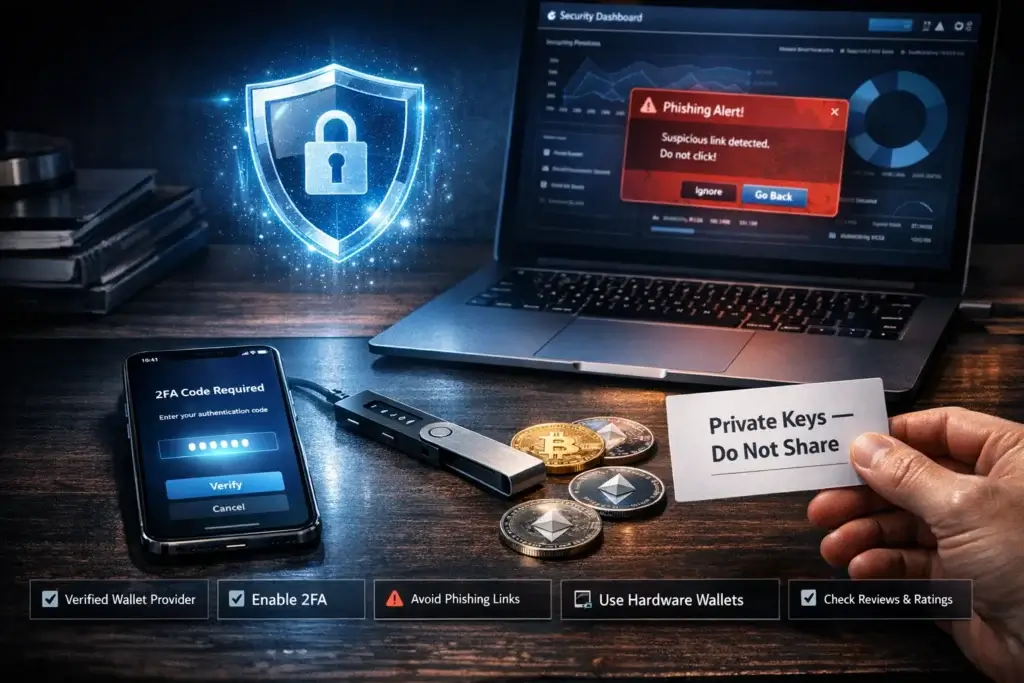
Selecting the right crypto wallet is more important now than ever. In 2025, the cryptocurrency world saw theft and fraud reach levels that broke previous records. By mid-year alone, more than $2.17 billion was stolen across hacks, scams, and exploits, already surpassing the total for all of 2024. A significant portion of this was tied to compromised wallets, not just exchange breaches. About 23 % of thefts targeted individual users’ wallets as attackers shifted focus from big platforms to everyday holders.
Wallet security isn’t theoretical. People around the world are losing real money because they trusted a poorly protected wallet or fell for a cleverly disguised scam. Some attacks now use AI-generated phishing, fake apps, or look-alike web pages that trick even seasoned users.
In this post, you’ll learn how wallets differ, what security really means, and how to spot fraud before it hits you. We’ll mix simple tips, plain language explanations, and practical checklists so you can protect your crypto with confidence.
What Is a Crypto Wallet?
A crypto wallet is a tool that lets you access and manage your cryptocurrency on the blockchain. It does not store your coins in a physical sense. What it actually stores are your private keys, the secret codes that prove you own your funds and allow you to send them.
If someone gets your private key or recovery phrase, they control your crypto. There is no reset button. No customer support line can undo it. That is why wallet security matters more than the app design or the brand name.
At a high level, wallets fall into two main categories.
Hot Wallets
These are connected to the internet.
Common examples:
- Mobile apps
- Desktop software
- Browser extensions
- Web wallets on exchanges
Why do people use them
- Fast to set up
- Easy to use for trading, NFTs, and DeFi
- Free in most cases
Main downside
- Being online makes them a bigger target for phishing, malware, and fake apps
Cold Wallets
These stay offline most of the time.
Common examples:
- Hardware wallets (USB-like devices)
- Paper wallets
- Air-gapped devices
Why do people use them
- Private keys never touch the internet
- Much harder for hackers to reach remotely
Main downside
- Cost money
- Less convenient for frequent transactions
Quick Comparison
| Feature | Hot Wallet | Cold Wallet |
| Internet connection | Always online | Offline |
| Security level | Medium | High |
| Ease of use | Very easy | Moderate |
| Best for | Daily use, trading | Long-term storage |
Crypto Wallet Types Every User Should Know in 2026
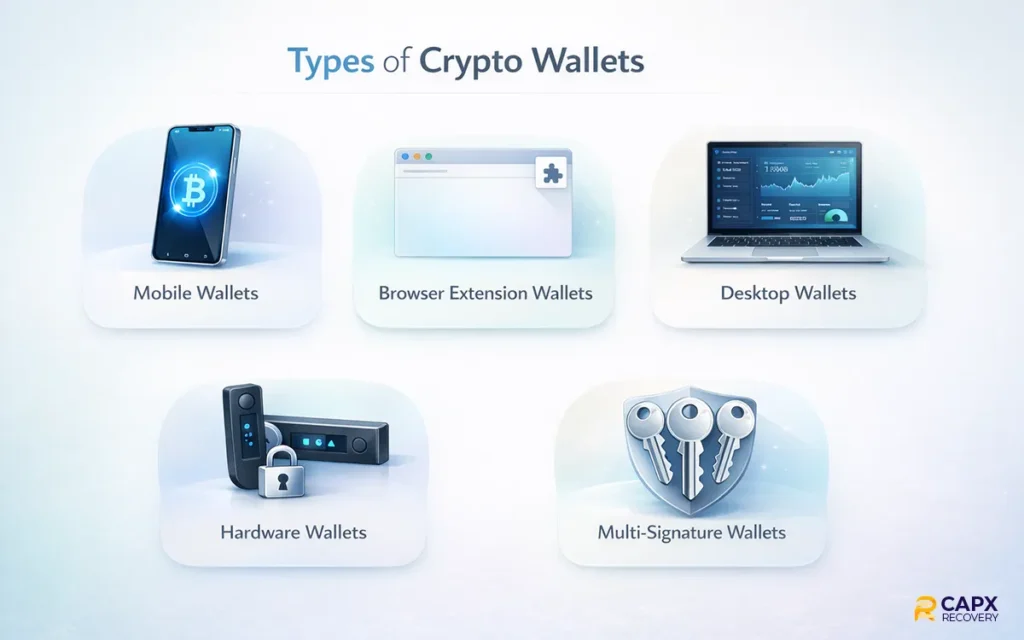
Most people no longer use just one wallet. They mix different types based on how often they trade and how much they hold. Think of it like cash and a savings account. You would not carry everything in your pocket.
Below are the wallet types that matter most in 2026.
Mobile Wallets
Apps installed on your phone.
Common use:
- Daily transactions
- NFTs
- DeFi apps
- Quick transfers
Pros:
- Very convenient
- Good user experience
- Easy QR payments
Cons:
- Risk if your phone is hacked, lost, or infected
- Fake wallet apps still appear on app stores
Best for: small to medium balances you use often.
Browser Extension Wallets
Wallets that run inside Chrome, Brave, Firefox, etc.
Common use:
- Web3 apps
- DeFi platforms
- Token swaps
Pros:
- Fast access to dApps
- Widely supported
Cons:
- Vulnerable to phishing sites
- Malicious extensions can steal data
Best for: active DeFi users who understand basic security.
Desktop Wallets
Installed directly on your computer.
Pros:
- More control than web wallets
- Can be paired with hardware wallets
Cons:
- Malware risk if your PC is compromised
Best for: users who prefer managing funds on a laptop or PC.
Hardware Wallets
Physical devices that store keys offline.
Pros:
- Strong protection against online attacks
- Transactions must be confirmed on the device
Cons:
- Cost money
- Can be lost or damaged if not backed up
Best for: long-term holders and large balances.
Multi-Signature Wallets
Require approval from two or more keys to send funds.
Pros:
- Stops single-point failure
- Great for teams and businesses
Cons:
- More complex setup
Best for: companies, DAOs, or shared funds.
Quick Overview
| Wallet Type | Security | Convenience | Best Use |
| Mobile | Medium | High | Daily spending |
| Browser extension | Medium | High | DeFi, Web3 |
| Desktop | Medium–High | Medium | Personal management |
| Hardware | Very high | Low–Medium | Long-term storage |
| Multi-sig | Very high | Low | Shared funds |
Security Principles Every Crypto Wallet Owner Should Know
The wallet you choose matters. How you use it matters even more. Most successful crypto thefts happen because of simple mistakes, not advanced hacking.
These basics will protect you no matter which wallet type you use.
Protect Your Recovery Phrase Like Cash
Your seed phrase is the master key to your wallet.
Do this:
- Write it on paper or metal
- Store it in two separate secure locations
- Keep it offline
Never do this:
- Save it in Google Drive or screenshots
- Share it with anyone
- Enter it on websites or in chat
If someone asks for your seed phrase, it is always a scam.
Use Strong, Unique Passwords
Weak passwords still cause a huge number of wallet takeovers.
Good practice:
- At least 12–16 characters
- Mix of words, numbers, symbols
- Different passwords for every wallet and exchange
A password manager helps, but protect the master password carefully.
Turn On Two-Factor Authentication
If your wallet or exchange supports 2FA, enable it.
Best options:
- Authenticator apps (Google Authenticator, Authy, etc.)
- Hardware security keys for advanced users
Avoid SMS 2FA if possible. SIM-swap attacks are still common.
Lock Down Your Devices
Your wallet is only as safe as the device running it.
- Keep your system updated
- Install apps only from official sources
- Use antivirus and firewall software
- Do not jailbreak or root phones used for crypto
Be Careful Where You Connect
Public Wi-Fi is risky.
- Avoid using wallets in cafés or airport networks
- Use your mobile hotspot when possible
- Consider a VPN for extra privacy
Simple Rule To Remember
If your wallet, device, and habits are secure, scammers have very little to work with.
How to Spot and Avoid Wallet Related Scams
Scammers don’t break in through the front door. They trick you into opening it. If you want a deeper breakdown of today’s most common crypto scams and how to report them, then read the full cryptocurrency scams guide.
In 2025, most stolen crypto came from social engineering, fake apps, phishing links, and wallet drainers. These attacks target people, not blockchains.
Once you know the patterns, they become easier to spot.
Common Wallet Scam Types
- Phishing websites: Fake versions of wallet sites that look real but steal your keys when you log in.
- Fake wallet apps: Clones uploaded to app stores or shared in Telegram groups.
- Airdrop and giveaway scams: Messages claiming you won tokens and must connect your wallet to claim them.
- Support impersonation: Scammers posing as MetaMask, Trust Wallet, or exchange support. Telegram remains one of the most abused platforms for wallet scams.
- Address poisoning: Attackers send tiny transactions from addresses that look similar to yours, hoping you copy the wrong one later.
- Malicious smart contracts: Connecting your wallet once can silently permit attackers to drain funds.
Red Flags That Should Stop You Immediately
- Someone contacts you first about crypto
- Pressure to act fast or lose money
- Requests for your seed phrase or private key
- Links that look slightly misspelled
- Offers that guarantee profit
- Requests to “verify” your wallet
Real wallet companies never DM users and never ask for recovery phrases.
Quick Safety Habits That Work
- Type wallet website URLs manually
- Bookmark official sites
- Double-check app developer names
- Verify contracts before signing
- Use a separate wallet for DeFi testing
- Keep large funds in cold storage
Scam Vs Safe Behavior
| Situation | Scam signal | Safe response |
| Email about urgent wallet issue | Panic language + link | Visit the official site manually |
| Telegram support message | Asks for the seed phrase | Block and report |
| New token in your wallet | Unknown project | Do not interact |
| DApp asks for full access | Unlimited approvals | Reject |
One Simple Rule
If anything asks for your seed phrase, stop.
If anything feels rushed, stop.
If anything sounds too good, stop.
Crypto Wallet Security Checklist
This is a simple setup you can follow, whether you’re new to crypto or tightening security on an existing wallet.
Before Creating Or Installing A Wallet
- Update your phone or computer
- Install system updates
- Enable device lock (PIN, fingerprint, or face ID)
- Install a basic antivirus on the desktop
- Clear old suspicious browser extensions
This takes 10 minutes and removes a lot of hidden risk.
When Creating Your Wallet
- Download only from the official website or app store
- Verify the developer name
- Create the wallet offline if possible
- Write down the recovery phrase by hand
- Store backups in two secure places
- Set a strong password
- Enable 2FA if supported
If you plan to hold a large amount, move funds to a hardware wallet right away.
After Setup
- Send a small test transaction first
- Bookmark the official wallet site
- Disconnect unused dApps
- Review token permissions
- Disable browser popups
- Turn on transaction notifications
Ongoing Habits
- Check wallet activity regularly
- Rotate passwords every few months
- Keep software updated
- Never reuse your seed phrase
- Avoid clicking crypto links from social media
- Separate wallets for:
- Long-term savings
- Daily use
- DeFi experiments
Risk Level By Setup Type
| Setup | Risk Level | Notes |
| Single hot wallet only | High | Easy target |
| Hot wallet + cold storage | Medium | Balanced |
| Hardware + separate hot wallet | Low | Recommended |
| Multi-sig + hardware | Very low | Advanced users |
This checklist alone can prevent most wallet-related losses.
Real World Crypto Scam Case Studies
Reading about scams is one thing. Seeing how they play out makes the risks real.
In early 2025, a large DeFi user lost over $6 million after signing what looked like a routine approval transaction. The contract quietly granted unlimited access to their wallet. Funds were drained within minutes. No password was broken. No device was hacked. One signature was enough. Many of these attacks are run by organized cybercriminal groups using social engineering and automation.
Another common pattern involved fake browser extensions. Thousands of users installed wallet clones that looked identical to the real thing. Once they imported their recovery phrases, the wallets were emptied almost instantly. Many victims said they found the links through search ads or Telegram groups.
There were also cases where attackers used address poisoning. They sent tiny transactions from addresses that closely matched the victim’s real contacts. Later, when the victim copied an address from their history, they unknowingly sent funds to the attacker instead.
Across these cases, the same themes repeat:
- Users trusted links or apps without verifying them
- Recovery phrases were entered online
- Permissions were granted without checking
- Large balances were kept in hot wallets
The technology did not fail. Human habits did. That is good news. It means most losses are preventable.
Immediate Steps to Take After a Crypto Scam
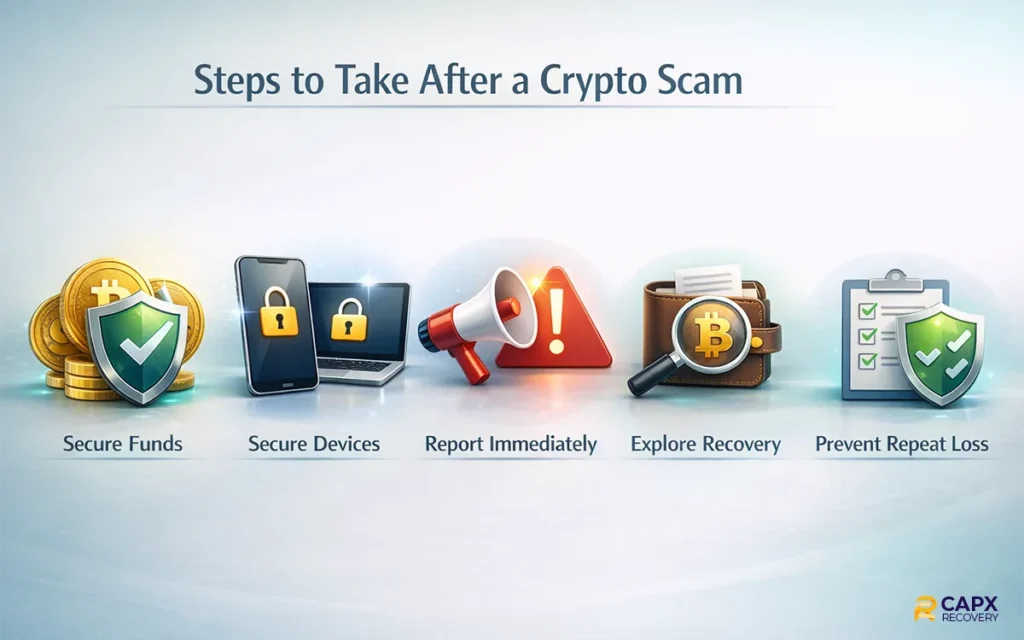
If you ever realize something is wrong, act fast. The first few minutes matter most.
Step 1: Secure What’s Left
- Move any remaining funds to a new, clean wallet
- Revoke all token approvals
- Disconnect your wallet from all dApps
- Change passwords linked to exchanges or email
Step 2: Lock Down Your Devices
- Run a malware scan
- Remove suspicious apps or browser extensions
- Update your system
Step 3: Report It
- Contact your wallet provider or exchange
- Report to your local cybercrime unit
- Save transaction hashes and wallet addresses
Learn how blockchain investigators trace stolen crypto using on-chain analysis.
Step 4: Understand Your Options
Recovery is hard in crypto, but not always impossible. Specialists can trace stolen funds and sometimes help in investigations or exchange freezes. Professional cryptocurrency scam recovery services may help trace stolen funds and assist with legal reporting.
You may find these helpful:
- Cryptocurrency scams guide: spotting, reporting, and recovery
- Who cybercriminals are and how they operate
- Common Telegram scams to watch for
- Cryptocurrency scam recovery services
- How crypto forensics works
Even if funds cannot be recovered, reporting helps prevent the same scam from hurting others.
Why Security Should Come Before Convenience?
Choosing a crypto wallet is not about finding a perfect app. It is about reducing risk. Hot wallets are great for everyday use. Cold wallets are better for serious savings. Using both is often the smartest move. But no wallet can protect you if basic habits are ignored.
Most losses happen because of rushed decisions, fake links, leaked recovery phrases, or blind trust in strangers online. Slow down. Double-check. Keep your keys offline. Separate long-term funds from daily spending.
Crypto gives you full control over your money. That freedom is powerful, but it comes with responsibility. Get the setup right once, follow simple security rules, and you dramatically lower the chances of ever needing to deal with fraud in the first place.
Frequently Asked Questions (FAQs)
Can a crypto wallet be hacked?
Yes, but most attacks target users, not the wallet software itself. Phishing links, fake apps, malware, and leaked recovery phrases are the main causes. If your seed phrase stays private and your device is secure, the risk drops sharply.
Is it safe to keep crypto on exchanges?
Exchanges are convenient, but they control the private keys, not you. If the exchange is hacked or freezes withdrawals, your funds may be stuck. Long-term holdings are safer in a personal wallet you control.
What should I do if someone gets my recovery phrase?
Move your funds immediately to a new wallet with a new recovery phrase. Assume the old wallet is permanently compromised. Do not reuse the same phrase under any circumstances.
Are free crypto wallets trustworthy?
Many free wallets are legitimate, but some are fake. Only download wallets from official websites or verified app store listings. Always check the developer name and reviews before installing.