

You deposit crypto, watch your account balance grow, and then request a withdrawal. Instead of receiving your money, you get a message asking for a tax, AML charge, verification payment, or “unlock” fee.
This may be more than a normal withdrawal delay. Fake crypto platforms often use blocked withdrawals to pressure victims into sending even more money. US regulators have warned about scams where victims must pay fake fees or taxes before receiving supposed investment profits.
A withdrawal problem does not always prove that an exchange is fraudulent. Security checks, network issues, maintenance, and account verification can also delay a transaction. The key question is whether the platform is applying a normal restriction or demanding a new payment before releasing your funds.
This guide explains how these scams work, what warning signs to look for, how to preserve transaction evidence, and what steps may be available for recovering funds after a crypto withdrawal scam.
What Does “Can’t Withdraw Crypto” Mean?
A blocked withdrawal can happen for several reasons. A real exchange may pause withdrawals after you change your password, log in from a new device, or show unusual account activity. It may also pause one specific coin because of network congestion or scheduled maintenance.
Other common reasons include unfinished identity checks, an unsupported blockchain network, a wrong wallet address, a withdrawal limit, a short outage, or a routine compliance review. None of these mean your money is gone for good.
A real exchange should explain the delay through its official website or a verified support channel. It might ask you to confirm your identity or wait until maintenance ends. It should never ask you to send crypto to an unknown wallet just so you can access money that is already yours.
Things get more serious when the platform takes your deposit but blocks your withdrawal, asks for a new payment before it will release your funds, demands a cut of your “profits,” or tells you to send a tax straight to the platform instead of taking it out of your balance automatically. It’s also a bad sign if a new charge shows up right after you pay the first one, or if you feel rushed to act fast.
A normal delay is worth looking into. A demand for payment first is a serious red flag.
How Do Fake Crypto Investment Platforms Actually Work?

Fake platforms mimic legitimate ones, appearing professional with features like live chat and market charts. However, they are deceptive, often replicating real exchanges with fake balances and support. Recognizing their tactics can help you identify red flags before investing further.
1. The First Contact
The scam often starts on social media, a dating app, a private investment group, an online ad, a messaging app, a fake support account, or through someone who calls themselves a trading expert. Some scammers spend weeks or months building trust. They talk about investing and show off screenshots of their own “profits.” Eventually they point you toward one specific website or app, and they’ll often call it exclusive or cutting-edge.
2. The First Deposit
The platform may accept a small first deposit with no problems at all. Your account then shows trading activity, profits, or a balance that keeps growing. Some platforms even allow one small withdrawal, which can make the whole thing feel legitimate. Once you trust it, the scammer pushes you to deposit more. A successful small withdrawal is not proof the platform is safe. It’s often just part of the setup.
3. The Fake Profits
A fake platform can build a dashboard that shows your deposits, trading profits, account level, pending withdrawals, transaction history, and portfolio value. It can look completely convincing. But a number on a screen does not prove that matching crypto exists in a wallet you actually control.
4. The Blocked Withdrawal
The trouble usually starts when you ask for a bigger withdrawal. The platform suddenly says you need one more step before it can pay you. That might mean a tax, an AML fee, a security deposit, an activation charge, an insurance payment, an “unfreezing” fee, or a final processing fee. The explanation can sound technical and official. But the real goal is almost always the same: get you to send more money.
5. The Payment Cycle
After you pay the first charge, a new problem often shows up. Maybe your account gets “flagged,” your payment was “too small,” or you need another level of identity verification. This can repeat until you stop paying. It works like a classic advance fee scam, where each payment is sold as the last one, right up until the next charge appears. The word “final” does not mean it’s actually final. It usually just means there’s another step coming.
Normal Fees vs. Fake Unlock Fees
Not all crypto fees are scams; legitimate transactions incur real costs. Exchanges typically deduct their fees from your withdrawal amount, clearly stating them in their fee schedule. However, be cautious if a platform asks for additional crypto to withdraw, requires you to move funds to another wallet, or mentions unexpected fees. Red flags include requests to pay fees via different networks or the appearance of multiple fees in succession. Always verify fees before proceeding with transactions.
For example, a legitimate exchange may show a $10 withdrawal fee and send the remaining amount to your wallet. A suspicious platform may say:
“Send us $2,000 first, and we will release the $20,000 balance in your account.”
That second structure is a major advance-fee warning sign. The CFTC has warned that scammers may demand fake taxes or other costs before releasing supposed investment profits.
What Excuses Do Crypto Scammers Use to Block Withdrawals?
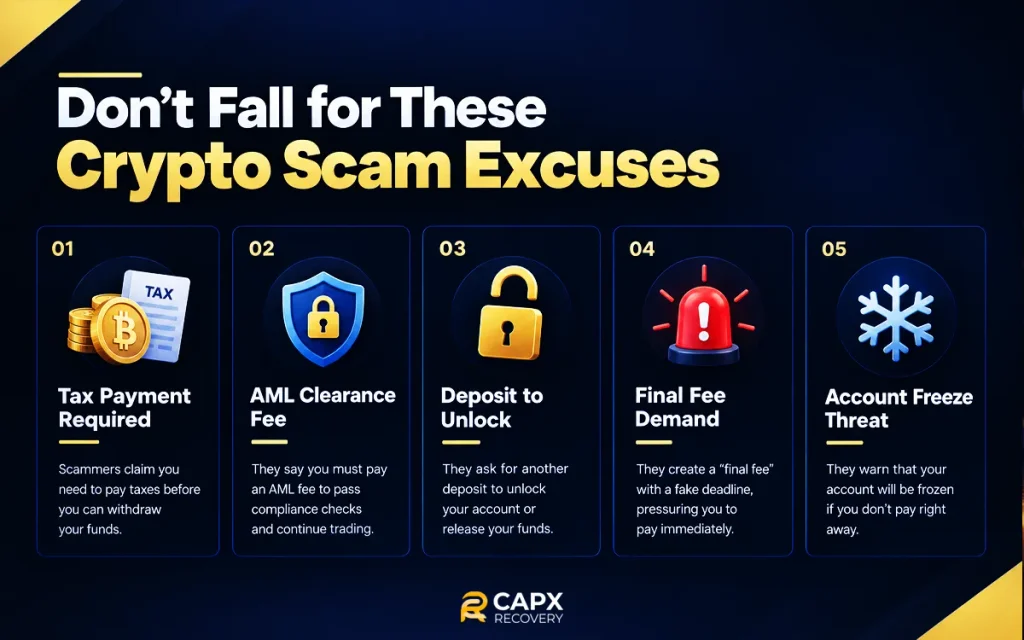
Scammers often use familiar financial and regulatory terms to make their demands sound official.
1 “You must pay crypto tax first”
The platform may say that your profits cannot be released until you pay tax. It may even use the name of a government agency or provide a fake tax document.
Do not assume that the message is genuine. Verify tax questions through an independent tax professional or the relevant government agency. Do not rely on the platform’s own explanation.
2 “Your account failed AML checks”
AML means anti-money laundering. It is a real compliance term, but scammers can misuse it to justify a fake charge.
A platform may say your account needs “AML clearance” and demand payment before withdrawal. Ask why a separate crypto payment is required and whether the charge appears in the platform’s official terms.
3 “Deposit more to unlock the account”
The platform may claim that you need to deposit a certain amount before withdrawals are enabled. It may call this a verification deposit, activation payment, or security reserve.
This is one of the clearest warning signs. You should not have to send more funds simply to access a balance that is already shown in your account.
4 “Pay the final release fee”
The word “final” is often used to create hope and urgency. If the platform asks for another payment after you have already paid one, stop and review the entire situation.
5 “Your account will be frozen permanently”
Scammers may threaten to delete your account or send your funds to the government. These threats are designed to stop you from taking time to verify the claim.
Pressure is not proof. A genuine financial service should allow you to understand the reason for a restriction and access its official complaints process.
Is the Balance on My Dashboard Actually Real Crypto?
A number displayed on a website does not guarantee ownership of the crypto it represents. Scammers can create dashboards with fake data, including deposits and profits, that exist only in their database.
To verify, check the transaction that sent your funds. Identify the receiving wallet, the blockchain used, and the transaction’s confirmation status. Look for real on-chain evidence of your profits. Use a blockchain explorer to track fund movement, but remember it won’t reveal wallet control or reverse transactions. Collect evidence from your dashboard, blockchain transactions, and exchange records for reporting.
What to Do When a Withdrawal Is Blocked

- Stop sending money. Don’t pay another tax, AML charge, verification fee, insurance payment, commission, unfreezing fee, or release fee. If the platform is a scam, another payment will likely just grow your loss.
- Save the evidence. Before you block the scammer or delete the app, save the website address, app name, account screenshots, balance history, withdrawal requests, error messages, payment demands, emails, phone numbers, usernames, wallet addresses, TXIDs, bank or card records, referral links, and any ads involved. Take full-page screenshots that show the website address and date whenever you can.
- Build a timeline. Write down when you first met the person or found the platform, when you opened the account, when you made each deposit, when you asked to withdraw, what the platform told you, what it asked you to pay, what you actually paid, and what happened next. A clear timeline makes your report much easier for others to follow.
- Lock down your accounts. If you shared a password or clicked a suspicious link, change your passwords, turn on multifactor authentication, sign out of unknown devices, revoke any unknown API keys, check your email forwarding rules, review your wallet permissions, and move your remaining assets if your wallet may be exposed.
Never share your seed phrase or private key with the platform, a support agent, or a recovery company. Fake wallet apps and impersonation scams often ask for recovery phrases or wallet credentials, so it’s worth learning how fake wallet apps steal crypto so you can avoid a second loss.
- Reach out to the legitimate service directly via their official website or app. Avoid using contact details provided by the suspected scammer. While they may not reverse blockchain transactions, they can help flag addresses and provide guidance on reporting options.
What Is a TXID and Why Does It Matter?
A TXID, short for transaction ID, is the unique code for a blockchain transaction. Some people call it a transaction hash. You can usually find it in your exchange withdrawal history, your wallet’s activity log, a confirmation email, a blockchain explorer, a crypto ATM receipt, or a payment service record.
Try to save the cryptocurrency type and amount, the sending and receiving wallet addresses, the blockchain network, the transaction hash, the date and time, screenshots, the platform’s URL, and any messages tied to the transfer. The FBI says these transaction details, wallet addresses, amounts, cryptocurrency types, dates, times, and transaction hashes, are some of the most useful information a victim can hand over when reporting crypto fraud.
Don’t edit your screenshots or delete your messages. Keep the original files whenever you can. If you’re not sure where to find your transaction details, Capx Recovery’s guide on what happens after reporting a crypto scam walks through how to preserve transaction records and blockchain evidence.
How to Report a Crypto Withdrawal Scam
If you are in the United States, report the scam even if the amount was small or you are unsure whether the funds can be recovered.
1 FBI Internet Crime Complaint Center
Submit a report through the official FBI Internet Crime Complaint Center.
Include:
- website and app details
- wallet addresses
- cryptocurrency type and amount
- transaction hashes
- dates and times
- phone numbers and email addresses
- usernames and aliases
- screenshots
- communication platforms
- a timeline of events
The IC3 complaint form also asks for originating and recipient wallet addresses.
If you do not have every detail, report what you do have. Missing information should not stop you from filing.
2 Federal Trade Commission
You can also submit a report through the FTC’s official ReportFraud.gov portal.
The FTC collects fraud reports and uses them to identify patterns. A report does not guarantee that your money will be returned, but it can help authorities understand how the scam operates.
3 CFTC and other regulators
If the platform presented itself as an investment or trading service, consider reporting it to the relevant financial regulator. The CFTC warns about fake investment websites that lock users out and demand more money in fake fees or taxes.
You may also contact the financial regulator in your state, especially if the platform claimed to be licensed in the United States.
4 Be careful of fake reporting agents
The FBI has warned that criminals may impersonate IC3 or other official bodies. Use official government websites rather than links sent by strangers. Do not pay anyone who claims to be an FBI or IC3 representative and promises to recover your funds.
Can Crypto Funds Be Recovered?
Recovery is not automatic. No legitimate provider can guarantee that stolen cryptocurrency will be returned.
The outcome may depend on:
- how quickly the scam was reported
- whether the funds reached a known exchange
- whether the destination wallet can be connected to a real-world service
- whether the assets were moved through several networks
- the quality of the available records
- the legal process involved
It is also important to understand the difference between tracing and recovery.
| Term | Meaning |
| Tracing | Following the movement of funds across blockchain addresses. |
| Attribution | Connecting an address or service to a real-world person or organization. |
| Freezing | Restricting access to funds through a provider or legal process. |
| Recovery | Returning assets to the victim. |
Victims often confuse tracing with recovery. Blockchain tracing can reveal where funds moved, while recovery depends on many factors, including exchange involvement, legal processes, and available evidence.
To better understand how recovery assessments work after a scam, read what happens after you report a scam to capx recovery.
Victims who need help organizing transaction records or understanding possible next steps may consult a crypto withdrawal scam recovery specialist such as Capx Recovery. Before hiring any provider, verify its identity independently, ask for written terms, understand the fees, and avoid anyone promising guaranteed results.
Watch Out for a Second Recovery Scam
Victims of crypto scams often face a second scam. This typically begins with an unsolicited message from someone posing as a blockchain investigator, lawyer, or recovery specialist, claiming to have found your funds and requesting upfront payment.
Be cautious of guarantees of recovery, unexpected contact, urgent payment demands, and requests for sensitive information like your seed phrase or private key. The IC3 warns against recovery services that charge upfront fees, as legitimate providers do not require such information just to review your transaction history.
How to Check an Exchange Before Depositing
Check an exchange before sending money. Verify its legal name, business address, customer support, terms of service, and privacy policy. A professional website alone isn’t sufficient; confirm its legitimacy through the regulator’s official site, not just the platform’s claims.
Review withdrawal rules carefully before depositing: fees, minimum amounts, and processing times. Recommendations from friends or influencers don’t guarantee safety. Research the platform independently and be wary of promises of high returns, as they may indicate potential scams.
Stop Paying, Save the Trail
A blocked crypto withdrawal doesn’t always indicate fraud; it could be due to security checks or network issues. Be cautious if a platform demands more money to release your funds, labeling it as a tax or fee. Stop paying if requests change frequently.
Keep records of all transactions and contact verified service providers for assistance. Research any professional help before sharing personal information, as legitimate services won’t guarantee recovery or ask for your seed phrase. For further guidance on crypto scams, consider resources from Capx Recovery.
FAQ
Do legitimate crypto exchanges charge withdrawal fees?
Yes. Most exchanges charge standard withdrawal or blockchain network fees, which are usually disclosed before you confirm the transaction. Legitimate platforms do not require unexpected payments to unlock or release existing account balances.
Why is a crypto platform asking for taxes, AML fees, or security deposits?
Scammers often use terms such as "tax clearance," "AML verification," or "security deposits" to make payment requests appear legitimate. Before sending money, confirm the requirement through official exchange documentation or independent regulatory sources.
Can a fake crypto platform show profits and account balances?
Yes. Fraudulent platforms can display fake profits, trading activity, and account balances to create the impression that funds are available. The problem often appears when users attempt to withdraw and are asked to pay additional fees.
What should I do if I paid a crypto withdrawal or release fee?
Stop sending additional payments immediately. Save transaction records, screenshots, wallet addresses, emails, and chat messages related to the incident. Secure your accounts and report the matter to the relevant authorities, exchange, or payment provider as soon as possible.