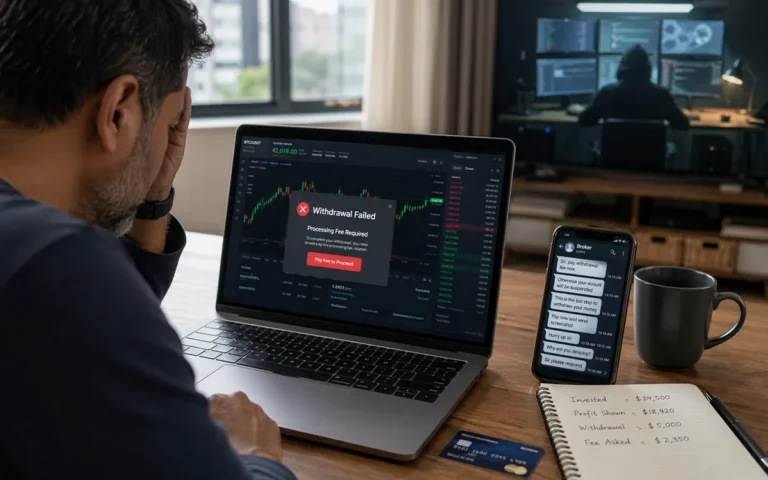

You deposit some money into a trading platform. Within days, your account balance is climbing. The dashboard shows green numbers, winning trades, and a growing profit. It feels good. Then you try to withdraw your money, and suddenly there’s a problem.
Table of Contents
You’re told you owe a release fee. Or an advance tax payment. Or a security deposit before your funds can be “unlocked.” You pay it, hoping this is the last step. It isn’t. Another fee appears. Then another.
This pattern shows up again and again in fake trading platforms, fraudulent brokers, and cryptocurrency investment schemes. It’s a form of advance-fee fraud, and if you’re in the middle of it right now, you’re probably already searching for withdrawal scam recovery options. This guide covers how these scams work, the warning signs to watch for, and what steps actually help, versus which ones just deepen the loss.
What Is a Trading Platform Release Fee Scam?
A release fee scam happens when a trading platform refuses to let you withdraw your money unless you pay an extra charge first. The platform might call it a release fee, a processing fee, an unlock fee, or something similar. Whatever the name, the idea is the same: pay more money to access money that’s supposedly already yours.
Here’s the part that makes this scam so effective. The account balance you’re looking at isn’t real. It’s a number on a screen, built by software the scammers control. They can make it go up whenever they want. There’s no actual trading happening, and there’s no actual profit sitting in an account waiting for you. The whole dashboard is a performance designed to keep you invested, both emotionally and financially.
Once you try to cash out, the platform has no reason to let real money go, because in most cases there isn’t any real money to send. So instead, they create a new obstacle. They tell you a fee needs to be paid before the “release” can happen.
Example scenario:
Someone deposits $2,000 into a trading app. Over a few weeks, the account balance grows to $8,000 through what looks like a string of successful trades. Excited, they request a withdrawal. The platform responds that a release fee of $400 is required to process it. They pay it. A day later, they’re told a second fee, this time for “wallet activation,” is needed. Then a third fee for “tax clearance.” The withdrawal never actually happens.
What Is an Advance Tax Payment Scam?

An advance tax payment scam is a specific version of the same trick. Instead of calling it a release fee, the scammers claim you owe taxes on your trading profits, and that this tax must be paid upfront before you can withdraw anything.
They might send a fake tax invoice. They might reference a “revenue department” or claim your country’s tax authority requires proof of payment before releasing investment gains. The language often sounds official, sometimes with logos or document formatting designed to look like a government notice.
This works because it plays on something people already understand: yes, investment profits are usually taxable. That sliver of truth makes the scam feel believable. But here’s how real taxes actually work. In almost every country, taxes on investment income are calculated and paid when you file your tax return, based on your actual gains for the year. No legitimate broker or exchange requires you to pay a tax bill directly to them before they’ll let you access your own funds. Taxes go to tax authorities, not to trading platforms.
If a platform is telling you to pay a tax-related fee directly to them, or to a private wallet address they provide, that’s not how taxation works anywhere. It’s a manufactured excuse to get another payment out of you.
Common phrases used in these scams:

- Tax clearance fee
- Profit tax payment
- Withdrawal tax
- Revenue department verification
- Government compliance charge
How These Scams Work: A Step-by-Step Breakdown
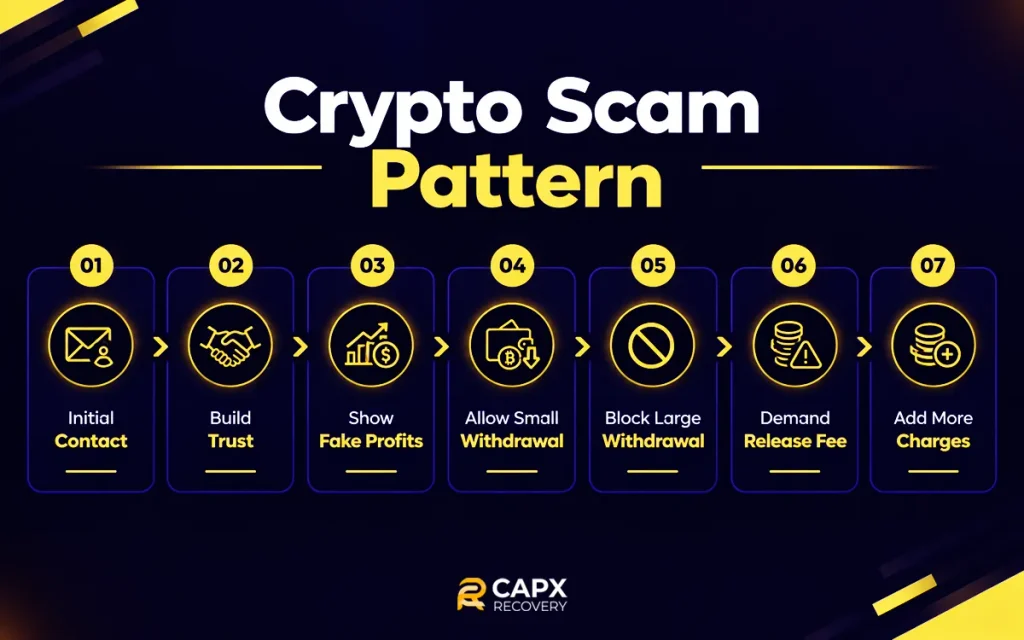
These scams tend to follow a predictable pattern. Recognizing each stage can help you spot one earlier, before serious money is on the line.
Step 1: Initial Contact
It often starts somewhere casual. A message on WhatsApp or Telegram. A comment or DM on social media. Sometimes it comes through a dating app, where a new romantic connection eventually brings up “a great investment opportunity.” Other times it’s a slick online ad promising huge returns with minimal effort.
Step 2: Building Trust
Once contact is made, the scammer plays the long game. They might present themselves as a friendly mentor or trading coach. They add you to a group chat filled with other “investors” sharing daily profit screenshots and success stories. Some of these group members are real victims. Many are fake accounts run by the same people behind the scam.
Step 3: Showing Fake Profits
You’re encouraged to sign up on a specific platform and make a small deposit. Almost immediately, the dashboard shows gains. The trading history looks detailed and realistic, but it’s fabricated. Returns are often unrealistically high, doubling or tripling an investment in days or weeks. In real markets, that kind of consistent growth almost never happens.
The balance you’re watching climb isn’t tied to any real trade. It’s a number the platform operator controls. If you’ve already deposited money into a setup like this, recognizing the signs is only the first step. The next is understanding what options may be available, including crypto investment scam recovery and the steps you can take to document what happened and assess your situation.
Step 4: Allowing Small Withdrawals
This step is key. Many of these scams will actually let you withdraw a small amount early on, maybe your original deposit plus a modest profit. This isn’t generosity. It’s a trust-building tactic. Once you’ve successfully pulled out money once, you’re far more likely to believe the platform is legitimate and invest more.
Step 5: Blocking Large Withdrawals
After you deposit a larger amount, the story changes. Your withdrawal request suddenly triggers a “security review.” You might see messages about pending verification, unusual account activity, or compliance checks. Days pass. Nothing gets resolved.
Step 6: Demanding a Release Fee
Eventually, you’re told there’s a fix. Just pay a release fee, a processing fee, a liquidity fee, or a clearance fee, and your funds will be freed up. It sounds reasonable in the moment, especially when a large sum feels within reach.
Step 7: Introducing Endless Additional Charges
Once you pay, a new charge appears. Verification fees. Security deposits. Anti-money laundering (AML) fees. Wallet activation fees. Insurance fees. Each one is framed as the final step. It rarely is.
Common Types of Withdrawal-Related Trading Scams
These scams tend to reuse the same core method with different labels. Here’s a quick rundown of the most common variations.
Release fee scam: A direct charge required to “release” your funds for withdrawal.
Advance tax scam: A fee framed as a required tax payment before funds can move.
AML compliance fee scam: A charge claiming your account needs anti-money laundering clearance.
Liquidity fee scam: A fee supposedly needed to generate liquidity so your withdrawal can be processed.
Account upgrade scam: A demand to upgrade to a “VIP” or “premium” account tier before large withdrawals are allowed.
Wallet verification scam: A fee tied to verifying or activating a crypto wallet before funds can be sent.
Warning Signs That a Trading Platform May Be Fraudulent
Some patterns show up across almost every version of this scam. Watch for these:
| Red Flag | Why It Matters |
|---|---|
| Guaranteed profits | Real markets carry risk. No legitimate platform can guarantee returns. |
| Pressure to invest quickly | Scammers don’t want you to slow down and think it through. |
| Unsolicited investment advice | Random contact from strangers offering investment tips is a classic scam opener. |
| No verifiable regulation | If you can’t confirm the platform is licensed with a real regulator, that’s a problem. |
| Crypto-only deposits | Crypto payments are hard to reverse, which is exactly why scammers prefer them. |
| Withdrawal restrictions | Sudden blocks or delays on withdrawals are one of the clearest signs something is wrong. |
| Unexpected fees | Charges that appear only after you try to withdraw are a hallmark of advance-fee fraud. |
| Aggressive support staff | Reps who push, guilt, or rush you are using pressure tactics, not customer service. |
None of these signs alone proves a scam. But if you’re seeing two or three of them together, especially withdrawal restrictions paired with new fees, it’s time to stop and reassess.
Legitimate Trading Fees vs Scam Fees
Real trading platforms do charge fees. The difference is in how and when those fees show up.
| Legitimate Platforms | Scam Platforms |
|---|---|
| Clearly disclose fees upfront | Reveal fees only after you try to withdraw |
| Transparent, published fee schedules | Requirements that keep changing |
| Deduct fees from your balance | Demand new payments from you |
| Follow documented, consistent procedures | Invent new excuses as they go |
| Allow normal, timely withdrawals | Delay withdrawals indefinitely |
Legitimate trading fees, withdrawal fees, and even tax reporting obligations are all things you can research and confirm independently, usually through the platform’s published terms or a regulator’s website. Scam fees show up suddenly, are tied directly to blocking your money, and can’t be verified anywhere outside the platform itself.
Why Victims Continue Paying Multiple Fees
It’s easy to look at this pattern from the outside and wonder how anyone falls for a second or third fee after the first one didn’t work. But there are real psychological reasons this happens.
By the time the first fee is requested, a person has often already invested real money and real time. Walking away means accepting that loss immediately. Paying “just one more fee” feels like the smaller, safer choice, even when it isn’t. This is the sunk-cost effect, and it affects smart, careful people just as much as anyone else.
There’s also fear at play. Fear of losing profits that felt real. Fear of having made a mistake. Scammers lean into this with urgency: limited-time windows, threats that the account will be frozen, or claims that delays will cause the funds to be forfeited entirely. Support agents are often trained specifically to apply this kind of pressure, offering reassurance one moment and urgency the next.
None of this reflects poorly on the victim’s intelligence. These scams are built by people who study human behavior and design their process around it. Understanding the social engineering tactics behind these schemes can make it easier to recognize the manipulation in the moment, rather than after the fact.
How to Respond to a Withdrawal Scam

Stop Sending Additional Funds
No matter how close the withdrawal seems, paying another fee almost never results in getting your money out. Pause before sending anything else.
Preserve Evidence
Save everything you can, including:
- Wallet addresses used for deposits or fee payments
- Transaction IDs
- Screenshots of your account dashboard and balance
- Emails and chat logs with the platform or “support” staff
- Any withdrawal requests and the platform’s responses
Secure Your Accounts
Change passwords on any accounts connected to the platform, including email. Review your crypto wallets and devices for anything unfamiliar.
Report the Incident
Depending on where you’re located, this might mean reporting to a financial regulator, a consumer protection agency, or local law enforcement. If you sent funds through an exchange, report it there too, since some exchanges can flag or freeze suspicious wallet addresses.
Victims often want to jump straight to recovering funds, which is understandable. But before moving forward, documenting what happened carefully can help establish a clear record of the incident. Transaction records, wallet addresses, and communication history may become important as you work through the crypto scam recovery process.
Can Funds Be Recovered After a Release Fee Scam?
This is the question everyone wants a straight answer to, and honestly, there isn’t one. Every case is different, and the outcome depends on several factors.
How the funds were sent matters a lot. Cryptocurrency transactions, once confirmed, can’t be reversed the way a credit card chargeback can. But blockchain transactions are also public and traceable, which means it’s sometimes possible to follow where funds moved after the fact, even if getting them back is a separate challenge.
The quality of your evidence matters too. Clear transaction records, wallet addresses, and communication history give investigators something concrete to work with. Timing plays a role as well. Funds moved quickly through several wallets or converted into different currencies become harder to trace the longer time passes.
It’s also worth being upfront about the limitations here. Recovery isn’t guaranteed, and anyone who tells you otherwise should raise a red flag of their own.
That last point matters, because a second wave of scams often targets people who’ve already been victimized once. These “recovery scams” involve companies that promise guaranteed fund recovery in exchange for an upfront payment. If a real trading platform scam started with a payment demand, such as a withdrawal fee scam, a recovery service that also demands payment before doing any real work should be treated with the same skepticism.
Understanding Your Recovery Options After a Trading Platform Scam
If you’ve been through this, your options generally fall into a few categories: reporting the scam through official channels, working with a professional investigator on transaction tracing, and gathering legal documentation in case any future action becomes possible.
None of these paths move quickly, and it’s important to set realistic expectations. Blockchain tracing can sometimes identify where funds went, but tracing funds and actually recovering them are two different things. Legal documentation can support a case, but building one takes time and doesn’t guarantee an outcome.
For people looking to understand this landscape better, Capx Recovery offers educational material explaining how transaction tracing, evidence review, and fraud investigations generally work, without promising results that can’t be guaranteed. If you want a clearer picture of what a legitimate fraud recovery process actually involves step by step, that kind of resource is a reasonable place to start.
How To Protect Yourself From Future Trading Platform Scams
Whether you’ve already been scammed or you’re just being cautious, these habits go a long way:
- Verify a platform’s regulatory status independently, through the regulator’s own website, not just claims made on the platform itself
- Research the company name, founders, and reviews before depositing anything
- Test withdrawals with a small amount before committing more money
- Be wary of unsolicited investment advice from strangers, even in friendly or romantic contexts
- Treat guaranteed or unusually high returns as a warning sign, not a selling point
- Never pay a new fee to access funds you already deposited or earned
- Download trading apps only from official app stores or verified sources
- Keep detailed records of every deposit, trade, and communication
FAQs
Is an advance tax payment required before withdrawing profits?
No. Legitimate taxes on investment gains are handled through your tax return, not through a payment demanded by the trading platform itself. Any platform asking for tax money directly is not following real tax procedures.
Why can't I withdraw money from a trading platform?
This usually happens when the platform is fraudulent and the balance shown was never backed by real trades or funds. Withdrawal blocks are often the first sign that something is wrong.
Are withdrawal verification fees legitimate?
Some legitimate platforms do have identity verification steps, but these are almost always free and don't require a monetary fee tied directly to releasing your funds. A fee attached to "verification" before withdrawal is a common scam tactic.
What is a crypto withdrawal tax scam?
It's a version of the advance tax scam specific to cryptocurrency platforms, where you're told a tax must be paid, often in crypto, before your coins or tokens can be withdrawn.