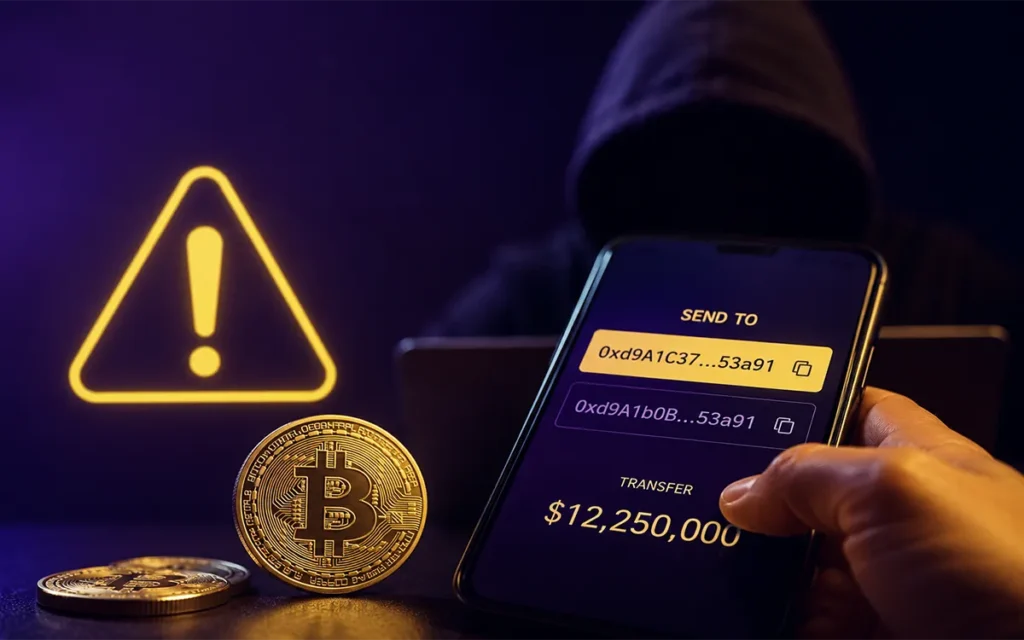
In December 2025, a crypto trader lost $50 million in USDT. In January 2026, another $ 12.25 million was lost. In March 2026, a well-known crypto influencer lost $24 million. None of these wallets were hacked. No passwords were stolen, no malware was involved. In each case, the victim simply copied the wrong address from their own transaction history and sent the funds themselves.
This is what an address poisoning scam looks like in practice. It’s one of the fastest-growing cryptocurrency scams targeting investors right now, and it works entirely by exploiting human behavior rather than any technical vulnerability.
In this guide, you’ll learn exactly how address poisoning works, why it’s so hard to identify at the moment, how to protect yourself, and what to do if you’ve already sent funds to a fake address.
What Is an Address Poisoning Scam?
An address poisoning scam is a crypto fraud in which scammers generate wallet addresses that visually mimic those you’ve used before, then plant them in your transaction history with a small transfer. When you later copy what looks like a familiar address, you send funds directly to the scammer. No hacking required.
Address poisoning doesn’t involve breaking into your wallet. It works by corrupting the transaction record you rely on.
Address poisoning is an attack vector that, unlike other scams that rely on phishing for your Secret Recovery Phrase or exploiting token approvals, depends entirely on user carelessness and haste above all else.
Wallet addresses are 42-character strings of letters and numbers. Nobody memorizes them. So most people copy and paste from past transactions – and that’s the exact habit this scam is built around.
The word “poisoning” describes what scammers do to your history. They inject a lookalike address into it, contaminating the record you naturally trust. Once that’s done, every future transaction is a potential trap.
Why It Doesn’t Require Hacking
Hacking means gaining unauthorized access to a system. Address poisoning requires neither. Receiving a transaction from a scammer’s address doesn’t have any negative impact in itself. The loss only happens when a victim mistakenly sends funds to the fake address.
Your private keys stay safe. Your wallet stays intact. You’re tricked into voluntarily sending your own money to the wrong destination.
How Does an Address Poisoning Scam Work?
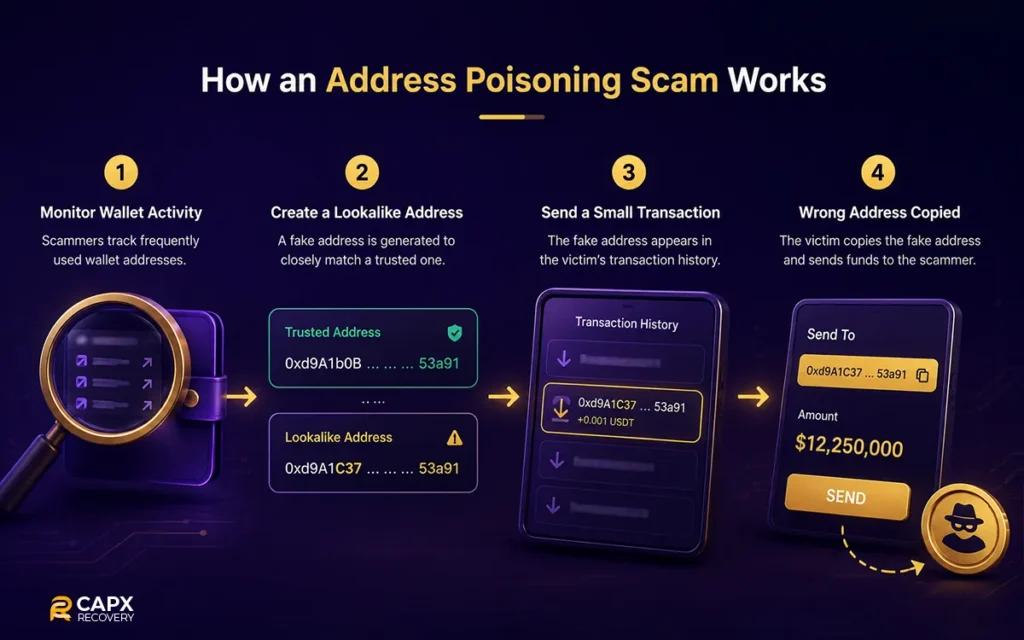
The mechanics are straightforward, which is exactly what makes this scam dangerous. Each step looks harmless. The damage only becomes visible after the final one.
Step 1: Scammers Monitor Public Blockchain Activity
Blockchains are public by design. Anyone can view any wallet’s full transaction history, including which addresses it sends to regularly and how much it holds. Scammers begin by studying a target’s transaction patterns, looking for frequently used addresses. Wallets with high balances and predictable activity are the most attractive targets.
Step 2: They Generate a Lookalike Wallet Address
Scammers algorithmically generate new crypto addresses until they create one that closely resembles the address the target most often interacts with. These are called vanity addresses, and the tools to create them are freely available.
Since they’re so long, crypto addresses are typically shortened – showing the first 5–10 characters and the final 5–10, skipping the middle. This is how most people recognize addresses: not by memorizing every character, but by becoming familiar with the start and finish. Scammers match exactly those parts.
A well-documented case shows exactly how this works: a scam address and a trusted address both began with “0xd9A1” and ended with “53a91.” The correct address read “0xd9A1b0B,” while the poisoned one read “0xd9A1C37.” Most users never spot the difference.
Step 3: They Send a Small Transaction
Once they have a convincing lookalike address, the scammer sends a small, seemingly harmless transaction from it – effectively “poisoning” the target’s address book. Usually, these are zero-value token transfers. Some scammers copy the exact amount from a previous legitimate transaction to make the entry look even more familiar.
Step 4: The Victim Copies the Wrong Address
The trap is set. The next time the victim needs to send funds, they scroll through their transaction history, spot what looks like the right address, and copy it without verifying every character. Since on-chain transactions are immutable once confirmed, any funds sent to the wrong address are irretrievable.
Why Are Address Poisoning Scams So Effective?
Most scams are easy to spot in hindsight. Address poisoning isn’t. It exploits the way crypto wallets are actually designed to be used – and it targets habits that even experienced users don’t think twice about.
Long wallet addresses make verification feel unnecessary. A 42-character string is impossible to memorize. Copying from history feels like the safe, efficient choice.
Familiarity bias fills in the gaps. When the first and last characters match, the brain assumes the rest is correct. Nobody expects the middle to be wrong.
Copy-paste culture is the default. Most web3 software facilitates copy-and-paste. Address poisoning speculatively exploits this tendency.
Blockchain transparency hands scammers the data they need. They don’t need to breach anything. Your transaction history is public.
This is fundamentally a social engineering attack. It exploits trust and habit rather than code. Address poisoning toolkits sold on darknet marketplaces include user-friendly interfaces, automated scripts to seed fake addresses with small payments, and step-by-step instructions. This makes it simple for even technically inexperienced scammers to run sophisticated campaigns.
Address Poisoning vs Wallet Hacking
People often assume they were hacked when they lose funds to wallet spoofing. These are two fundamentally different attacks.
| Address Poisoning | Wallet Hacking | |
| Method | Tricks the user | Compromises the wallet |
| Private keys | Never stolen | May be stolen |
| Who sends the crypto | The victim, voluntarily | The attacker, without permission |
| Attack type | Human error | Technical attack |
| Wallet access required | None | Full or partial |
| Prevention | Verification habits | Security practices |
With address poisoning, your wallet is completely intact. You send the funds yourself – just to the wrong place. With wallet hacking, an attacker gains access to your private keys or seed phrase and moves funds without your involvement.
Understanding this matters because the immediate response is different for each scenario.
Can Someone Access Your Wallet Through Address Poisoning?
No. Receiving a transaction from a scammer cannot compromise your wallet in any way.
There is no way to stop people – including scammers – from sending transactions to your address. These are public blockchains, so anyone anywhere can do as they please. A scammer sending you a zero-value token is no different from someone slipping a flyer under your door. It doesn’t unlock anything.
Your private keys remain safe. No data is transferred to the scammer when they send it to you. The only risk is what happens when you copy their address and send funds to it yourself.
This is worth emphasizing because many victims panic and assume their entire wallet is at risk. In an address poisoning attack, it isn’t. Only the funds sent to the fake address are gone – unless your seed phrase has been separately compromised.
Warning Signs of an Address Poisoning Scam
Most victims only recognize these signs after the fact. Knowing what to look for before you send is what separates a close call from an irreversible loss.
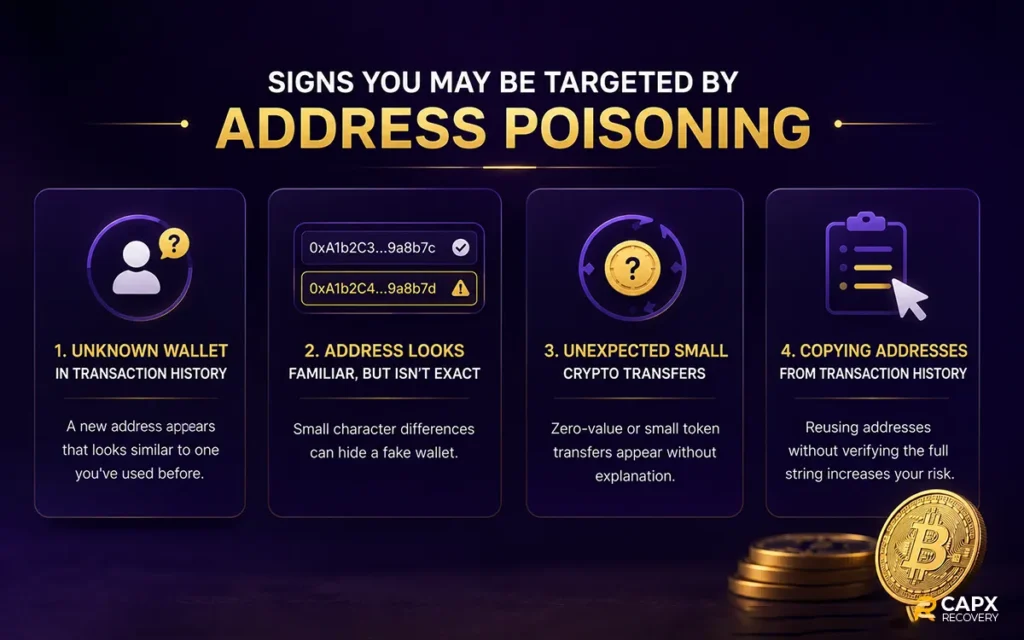
1. A New Wallet Appears in Your Transaction History
If you see an incoming or outgoing transaction involving an address you don’t recognize, and it looks similar to one you’ve used before, treat it as a poisoning attempt. Don’t assume it was a mistake.
2. The Address Looks Familiar but Isn’t Exact
The entire scam depends on you not checking the full address. If something feels slightly off, stop and verify every single character against a saved or independently confirmed source.
3. Unexpected Small Crypto Transfers
The most common fake transactions involve USDT, TRX, or MATIC, or a faked version of those tokens. Some entries copy the amount from a previous legitimate transaction to create a familiar-looking wallet entry. Others send entirely new tokens as a fake airdrop.
4. Copying Addresses From Previous Transactions
This is the core habit that enables the scam. If you regularly pull addresses from your history without checking the full string, you’re at risk every time.
How to Protect Yourself From Address Poisoning Scams
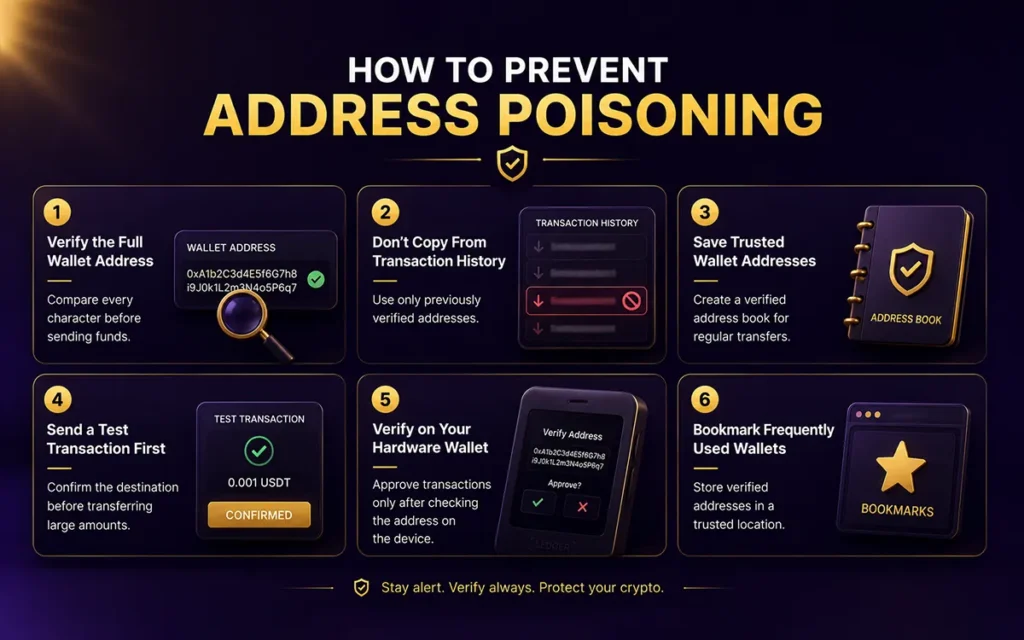
Prevention comes down to one discipline: slowing down before you send. Most address poisoning victims weren’t careless people – they were following the same habits that work fine 99% of the time. These steps break those habits in exactly the right places.
1. Always Verify the Full Wallet Address
This sounds obvious until you realize how rarely people actually do it.
Most users glance at the first four characters, check the last four, and hit send. That’s exactly the window scammers design their fake addresses around. The middle of a wallet address is where the difference lives, and it’s the part almost nobody reads.
Before every transaction, copy the destination address and compare it against your verified source, whether that’s a saved contact, a directly typed address, or one you’ve confirmed with the recipient through a separate channel. Go character by character. It takes 30 seconds. On a $50,000 transfer, that’s a reasonable investment.
One practical habit that helps: paste the address into a text editor and increase the font size before comparing. It sounds low-tech, but it makes subtle character differences much easier to catch.
2. Never Copy Addresses From Transaction History
Your transaction history feels like a safe place to pull addresses from. You’ve used those addresses before. They look right. That familiarity is exactly what this scam is betting on.
The problem is that scammers have already been there. They’ve studied your history, built a lookalike address, and planted it in the same list you’re about to scroll through. To you, it looks identical to the address you’ve always used. To them, it’s a trap that’s already set.
This applies to block explorers too, not just your wallet interface. If you’re copying an address from Etherscan because you saw a recent transaction there, you’re still pulling from a record that may have been poisoned.
The only safe approach is to copy addresses from a source that was verified before any suspicious activity could have touched it. A saved contact in your wallet app, a bookmarked address you confirmed personally, or a direct message from the recipient through a trusted channel you’ve already verified.
3. Save Trusted Addresses
The single biggest behavioral shift you can make is to stop copying addresses on the fly and start maintaining a list of verified ones.
In MetaMask, go to Settings and find the Contacts section. Add every address you send to regularly, labeling each one clearly. Once an address is in there and you’ve confirmed it’s correct, you never need to copy and paste from history again. You just select from your contact list and send.
Most major wallets offer this. Coinbase Wallet, Trust Wallet, and Ledger Live all have address book or contacts features. If you’re using a wallet that doesn’t, that’s worth factoring in when you consider whether it’s the right tool for moving significant value.
The time to build this list is before you need it, not in the middle of a transaction. Go through your recent history now, verify each address against a trusted source, and save the ones you use regularly. That single session could prevent a significant loss down the line.
4. Send a Small Test Transaction
When you’re moving a large amount to an address you haven’t used recently, or one you’re not 100% certain about, send a small amount first.
Pick a number that’s meaningful enough to confirm the transaction went through correctly, but small enough that losing it wouldn’t hurt. For most people, that’s somewhere between $5 and $20 worth of the token you’re sending.
Wait for confirmation. Check the block explorer and confirm the funds arrived at the exact address you intended. Only then send the full amount.
Yes, this costs you two sets of gas fees instead of one. On Ethereum, that can add up during periods of high network activity. But consider the math: if you’re sending $10,000 and you pay an extra $3 in gas to verify the address is correct, that’s a reasonable cost. If you skip the test and send to a scammer’s address by mistake, the entire $10,000 is gone with no recourse.
The test transaction habit is especially worth building if you’re sending to a new address for the first time, returning to an address you haven’t used in months, or moving an unusually large amount even to a familiar destination.
5. Use Hardware Wallet Verification
A hardware wallet adds one step to every transaction that most people find slightly annoying, and that step is the whole point.
Before funds leave your wallet, the device shows you the destination address on its own screen and asks you to physically confirm it. You have to look at the address displayed on the hardware device itself, not on your computer or phone screen, and press a button to approve.
This matters because a compromised computer can show you one address on screen while quietly sending to a different one. The hardware wallet bypasses that entirely. Whatever address appears on the device’s physical display is where the funds are actually going.
Get into the habit of reading the full address on the device screen before confirming, not just glancing at it. The verification step only protects you if you actually use it. Pressing confirm without checking defeats the purpose.
Choosing a safe crypto wallet with strong verification features adds a meaningful layer of protection against address poisoning and related attacks.
6. Bookmark Frequently Used Wallets
Transaction history is not a reliable address book. It was never designed to be one. It’s a record of what happened, and as we’ve covered, scammers can add entries to that record without your permission.
So stop relying on it as your go-to source for addresses.
Instead, build a small, verified list of the addresses you send to most often and keep it somewhere that can’t be tampered with. That could be your wallet’s built-in contacts feature, a note in a password manager, or even a physical notebook you keep offline. The format doesn’t matter as much as the fact that every address on that list was verified by you, at a time when you were certain it was correct.
When you add an address to your list, do it carefully. Cross-check it against at least two sources before saving it. Confirm it with the recipient directly if you can. Once it’s saved and verified, that’s the version you use going forward, not the one that appeared in your transaction history last Tuesday.
The goal is simple: the fewer times you’re copying and pasting addresses from untrusted sources, the fewer opportunities scammers have to catch you off guard. A bookmarked, verified list gets you as close to zero as possible.
What Should You Do If You Send Crypto to a Fake Address?
Act immediately. The faster you move, the better your options.
Step-by-step checklist:
- Confirm the transaction on a block explorer like Etherscan. Verify the destination address and the exact amount sent.
- Record everything – your wallet address, the scammer’s address, the transaction hash, and the timestamp. You’ll need this for every subsequent step.
- Contact the receiving exchange if the funds appear to be moving toward a custodial platform. Centralized exchanges can sometimes flag or freeze accounts before funds are withdrawn.
- File a report with the relevant authority – FBI IC3 (ic3.gov) in the US, Action Fraud in the UK, or the National Cyber Crime Reporting Portal in India. Also flag the scammer’s address directly on Etherscan.
- Seek professional investigation if the amount is significant. Blockchain analysts can trace fund movements and build documentation that may be essential for exchange cooperation or legal action.
Knowing what to do after a crypto scam is critical in those first hours. Every step you take early keeps more options open.
Can Stolen Crypto Be Recovered?
Blockchain transactions are irreversible by design. Once a transaction is confirmed, no wallet provider, exchange, or developer can undo it. That said, recovery isn’t always impossible – it depends on where the funds go next.
In one of the largest recorded address poisoning incidents, a victim lost $50 million in USDT in December 2025, and the entire path from receipt of funds to passing through a mixer took approximately 30 minutes. Once funds pass through a mixer or cross-chain bridge, the options narrow significantly, which is why early action matters more than almost anything else in these cases.
This is where professional cryptocurrency scam investigations come in. Blockchain analysts can trace exactly how stolen funds moved across wallets, exchanges, and protocols, building the kind of documentation that matters for exchange cooperation or law enforcement action. While recovery is never guaranteed, early reporting and professional tracing significantly improve the outcome. At Capx Recovery, our recovery process starts with exactly this kind of tracing the moment a case comes in.
Common Myths About Address Poisoning Scams
| Myth | Fact |
| My wallet has been hacked | Your wallet is intact. You sent funds voluntarily to the wrong address. |
| Receiving crypto gives hackers access | Receiving a transaction has zero security implications. |
| Blockchain is insecure | The blockchain worked as designed. Human behavior was exploited, not the protocol. |
| Wallet providers can reverse transactions | No one can reverse a confirmed blockchain transaction. |
The most harmful myth is the first. Believing your wallet was hacked can lead to panicked decisions – like importing your seed phrase into a new wallet under stress – that actually create new vulnerabilities. Understanding what really happened lets you respond calmly and correctly.
How Address Poisoning Scams Have Evolved in 2025–2026
Address poisoning has stopped being a niche attack. It’s now a fully industrialized operation, and 2026 data shows the scale clearly.
The Ethereum Fusaka upgrade in late 2025 slashed transaction fees dramatically, and scammers moved immediately. New address creation on Ethereum grew 2.7x relative to the 2025 average, and 67% of new addresses received a dust transaction as their first network interaction. Lower fees made mass poisoning campaigns economically trivial to run.
According to security researchers tracking these attacks, poisoning attempts jumped from 628,000 in November 2025 to 3.4 million in January 2026 – a 5.5x spike in just two months. One attacker contract sent 3 million dust transfers to over 1 million addresses for a total cost of just $5,175.
The losses are accelerating too. In December 2025, a victim lost $50 million in USDT after copying a fraudulent address from their own transaction history. In January 2026, another investor lost $12.25 million the same way. Then in March 2026, a well-known crypto influencer lost around $24 million in aEthUSDC after falling into a classic poisoning trap, with attackers quickly moving the funds through intermediary wallets and converting them into other tokens.
The research confirms the trend isn’t slowing. A Carnegie Mellon University study analyzing over two years of Ethereum and Binance Smart Chain data identified approximately 270 million attack attempts targeting 17 million victims, with confirmed losses of at least $83.8 million. And that’s a conservative floor – the researchers noted that many incidents go unreported entirely.
In January 2026, Citi analysts flagged a record-breaking surge in sub-$1 Ethereum transactions as a clear marker of an active poisoning campaign, noting that low transaction fees make it inexpensive for attackers to send out small payments at massive scale.
The attack has also shifted chains. While the primary battleground in 2024 was Tron, where USDT-TRC20 dominated volume and network fees were fractions of a cent, the center of gravity has shifted to Ethereum in 2025–2026 following the Fusaka upgrade.
The wallets themselves are responding. MetaMask has rolled out dedicated address poisoning detection in its send flow, comparing each pasted address against previously used ones and issuing a blocking warning if a lookalike is detected. Trezor Suite has introduced filtering for known poisoning patterns as well.
What Every Crypto User Should Remember
Address poisoning is one of the few crypto scams that requires no technical sophistication from the attacker – and no technical failure from the victim. It works entirely by exploiting the copy-paste habits most people use every day without thinking.
The defense is simple in theory but requires consistency in practice: verify every character of every address before you send, never copy from transaction history, and save trusted addresses in a verified contacts list. One extra minute of verification is the difference between a completed transaction and an irreversible loss.
If you’ve already sent funds to the wrong address, stop waiting. Every hour matters. Capx Recovery specializes in tracing stolen crypto across wallets, exchanges, and protocols. We’ve worked with victims who assumed their funds were gone permanently and found leads worth pursuing.
Our team knows how scammers move stolen funds, where they try to cash out, and what documentation gives you the best shot at recovery. Get a free case review and find out what’s still possible before the trail goes cold.
FAQ
Can someone hack my wallet by sending me crypto?
No. Receiving a transaction from any address, including a scammer's, has no impact on your wallet security. Your private keys remain safe. The only risk is if you later copy the scammer's address from your history and send funds to it yourself.
How do I know if a wallet address is fake?
You can't tell by checking only the first and last few characters - that's exactly what address poisoning relies on. Always compare the full address, character by character, against a saved and independently verified version. Block explorers like Etherscan also flag known scam addresses.
Can cryptocurrency sent to the wrong address be recovered?
Blockchain transactions are irreversible once confirmed. Recovery is sometimes possible if funds reach a centralized exchange that cooperates with law enforcement. Professional blockchain tracing and immediate reporting significantly improve the odds. Waiting reduces them.
Which wallets are most vulnerable to address poisoning?
Any wallet that displays transaction history without flagging lookalike addresses creates risk. Ethereum and EVM-compatible wallets are most commonly targeted. The attack also affects BNB Smart Chain and Toncoin. The vulnerability is behavioral, not wallet-specific.
Is address poisoning the same as phishing?
They're related but different. Phishing tricks you into surrendering your private keys or seed phrase. Address poisoning tricks you into sending funds to a fake address. Both are social engineering attacks, but your wallet is never compromised in an address poisoning attack.