You’re told your money is ready to be released, but there’s a catch.
Before you can withdraw, you’re asked to pay a tax, clearance fee, or processing charge.
At first, it feels normal. Taxes are part of financial transactions, and when your funds are already visible in an account, paying a smaller amount to access them can seem reasonable.
But this is where things start to go wrong.
Unfair tax practices are becoming increasingly common, especially in investment platforms, crypto transactions, and online trading environments. Victims are often pushed into paying misleading or completely fabricated charges. And once the payment is made, either new demands appear or access to funds is blocked entirely.
This guide breaks it down clearly. You’ll learn how these practices work, how to spot them early, and how Capx Recovery helps you take action and move toward recovering your money.
What Are Unfair Tax Practices?
Unfair tax practices are those that are requested to be paid by individuals in the form of taxes or fees that are either misleading, exaggerated, or even totally fabricated so that they can gain access to their own funds.
These requirements are usually sold as a just duty, yet, in the real sense, they are aimed at collecting extra payments from the victims.
Common examples include:
- To be informed that they will pay a tax first, and then they can withdraw money.
- Often, concealed fees are revealed once the deal is done.
- Unclear or unspecified tax calculations.
- Multiple payment requests are identified as clearance or processing fees.
In most instances, these are practices that are related to larger frauds. Victims might already be working with a bogus investment platform, a scammed trading account, or a frozen withdrawal request.
This is the place where unjust tax requirements are particularly successful. They are placed as an afterthought, something that is routine and must be done before getting money.
However, as opposed to legitimate processes of taxation, these demands are not transparent, well-documented, and authoritative.
Inherently, unfair tax practices are not compliance-based. They have to do with control. The aim is to ensure that the victims are kept busy and paid and cannot access their own money.
Common Situations Where Victims Face Unfair Tax Demands
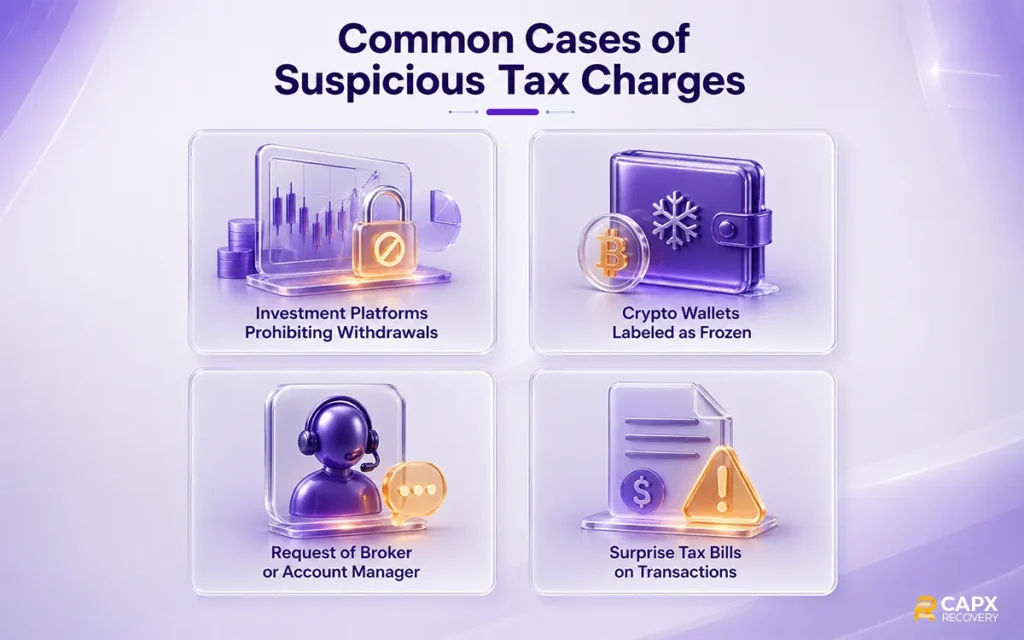
The unfair tax demands hardly emerge suddenly. They tend to appear at the most crucial time, when you need to get your money.
The most typical scenarios under which individuals face them are as follows:
1. Investment Platforms Prohibiting Withdrawals
You have earned some money on an internet site and choose to withdraw. As a requirement of paying a tax, the platform informs you that the request has to be processed.
The price can be in the range of what you have in your balance, and the request can be legitimate. However, after payment, the new fees or withdrawals are blocked.
2. Crypto Wallets Labeled as Frozen
You are informed that your wallet is limited because of tax compliance or regulatory reasons. In order to open it, one must pay a tax or clearance fee.
This frequently relates to the reasons scammers will say that your crypto funds are frozen and need to be unfrozen, and this is a way to keep victims interested and paying.
3. Request of Broker or Account Manager
A broker or account manager tells you that you cannot get your profits out until you pay some tax debt.
Since this is a message delivered by someone you have been dealing with, it is credible. This is actually frequently an organized fraud.
4. Surprise Tax Bills on Transactions
You make a purchase, and you are informed that there is an extra tax fee you have to pay before anything can be done.
It has little explanation, no formal dismantling, and is often under pressure to do it.
In every instance, the trend is similar. Control of access to your money is done, and positioning of payment is the only way out.
And it is what renders unfair tax practices so efficient. They come at the point when you are about to get a payout.
Why These Practices Work
Unjust tax requirements are effective since they appear valid on the surface.
Taxes are part and parcel of financial activity. So when somebody informs you that he needs to be paid in order to comply, it does not make you immediately suspicious. Rather, it becomes a habitual process.
Based on that assumption, scammers exploit three main triggers:
1. Authority
Anything touching on taxes is not light. Most individuals are reluctant to challenge an appeal that is presented as a legal or regulatory mandate.
2. Urgency
Victims are usually advised that the delays may result in punishment, blocking of accounts, or loss of money. This stress drives rushed judgments that are not verified.
3. Confusion
The rules of taxation are complicated. Most individuals are not certain about the way that they operate, and so, it is much easier to fall prey to misleading or incomplete explanations.
That is precisely how social engineering frauds influence victims into making urgent choices. The scenario is made to appear true, time-limited, and hard to disprove.
When these are combined, even seasoned people may be lured into making illogical payments that turn out illogical in retrospect.
How to Identify Unfair or Fraudulent Tax Demands
Not all payments connected with taxes are scams, but unjust or dishonest requests tend to have some trend. They are also much easier to find once you know what to look for.
These are the main indicators:
1. Advance Fee Before Accessing Funds
When you are required to pay some kind of tax before you can withdraw or access your money, it is a big red flag. The processes of legitimate taxation do not work so.
2. Absence of Official Documentation
No notice is given, no authoritative body that can be verified, and no clear disaggregation of the calculation of the amount.
3. Imprecise or Ambiguous Descriptions
They tell you that you have to pay, but the specifics do not work. It is generic or too difficult to explain without actual clarity.
4. The Need To Take Swift Action
It is pushed to make a payment without checking the situation, with the help of deadlines, threats, or warnings.
5. Repeated or Numerous Payments
Once a single payment has been made, there are other charges. They are all placed as the last stage, and the process is never successfully finished.
6. Unusual Payment Methods
Orders of crypto transfers, gift cards, or direct wallet payments, rather than conventional, traceable mechanisms.
When you see even one of these signs, then stop.
Tax misconduct depends on the momentum. By slowing down and checking, a small payment can be saved from becoming a huge loss.
How Capx Recovery Helps You
Dealing with unfair tax demands can be confusing, especially when you’re unsure whether the situation is legitimate or part of a larger scam. This is where Capx Recovery steps in.
The goal isn’t just to identify the problem but to take structured steps toward resolving it and, where possible, recovering lost funds.
Here’s how the process typically works:
Case Assessment
The first step is understanding your situation in detail. This includes reviewing communication, payment requests, platform activity, and any supporting information you have.
The aim is to identify whether the tax demand is legitimate or part of a fraudulent setup.
Evidence Collection
Once the situation is assessed, the next step is gathering all relevant evidence. This may include:
- transaction records
- emails and messages
- platform screenshots
- payment confirmations
This information becomes the foundation for any further action.
Investigation and Verification
Capx Recovery analyzes the details to detect patterns of manipulation or fraud. This includes evaluating how the tax demand was presented and whether it aligns with legitimate financial or regulatory practices.
At this stage, many cases reveal clear signs of unfair or deceptive behavior.
Recovery Strategy
Based on the findings, a structured recovery approach is developed. This may involve working through financial channels, dispute processes, or other appropriate steps, depending on the case.
Each situation is different, so the strategy is tailored accordingly.
Ongoing Support
Throughout the process, you’re guided on what actions to take and what to avoid. This helps prevent further losses and ensures that every step is handled with clarity.
Unfair tax practices are designed to confuse and pressure victims. Having a structured approach makes it easier to cut through that confusion and take informed action.
What to Do If You’re Facing Unfair Tax Charges
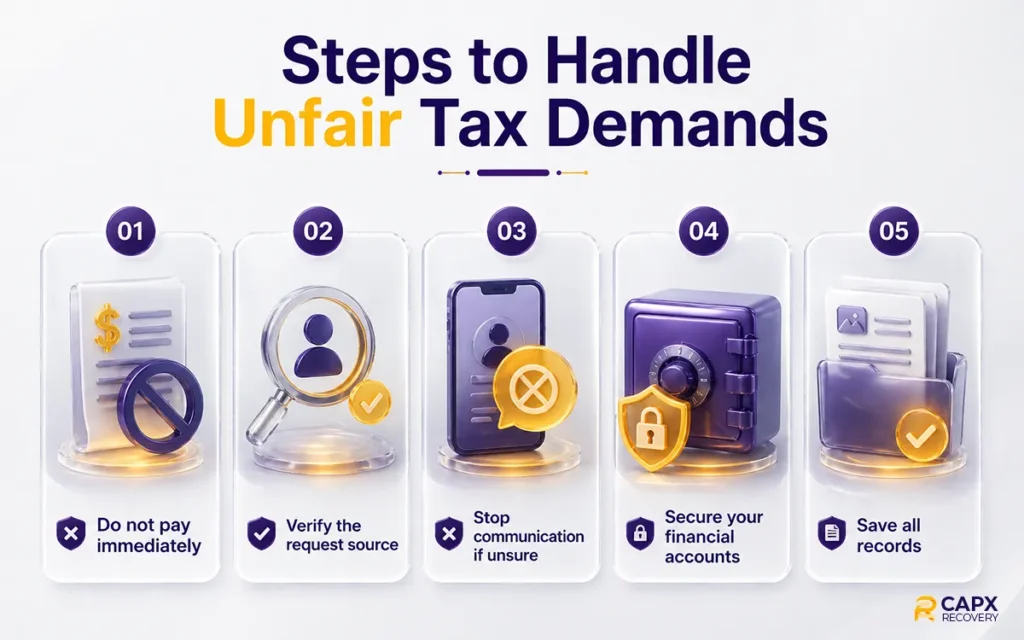
When someone is requesting you to pay a tax or fee to get your money, do not rush into it. Making a timely step backwards can save additional loss.
The following is what you need to do:
1. Do Not Make Immediate Payments
It is advisable not to send money immediately, even when the request seems urgent. Proper tax operations are not based on pressure or immediate deadlines.
2. Verify The Demand
Determine the credibility and verifiability of the request source. Find official records and explanations.
3. Halting Communication When Something Does Not Feel Right
When the replies are ambiguous, inconsistent, or obtrusive, withdraw. The further discussion usually results in increased pressure.
4. Keep Your Financial Accounts Safe
Change passwords, use two-factor authentication, and check your accounts to see abnormal activity.
5. Keep Records Of Everything
Store emails, messages, transaction details, and screenshots. This fact is essential in case you have to do something additional.
In case you are not sure of the situation or have already paid, seeking clarity early can make a difference. These requests in most instances adhere to similar patterns as those of advance fee scam schemes in tax and investment fraud, where they keep asking over and over again and never actually pay the debts.
The early action will keep you in control and prevent further financial damage.
How to Protect Yourself Going Forward
Once you’ve dealt with an unfair tax demand, the next step is making sure it doesn’t happen again. Most of these situations can be avoided with a few simple habits.
1. Always Question Tax-Related Payment Requests
If someone asks you to pay a tax before accessing funds, take a step back. Legitimate processes are transparent and verifiable.
2. Verify Platforms And Services Before Using Them
Whether it’s an investment platform, broker, or service provider, check credibility before committing money.
3. Avoid Relying On A Single Source Of Information
If something doesn’t feel right, cross-check it. Scammers rely on isolation and controlled communication.
4. Keep Records Of Transactions And Communication
Having a clear trail of activity makes it easier to identify issues early and take action if needed.
Stay Aware Of Common Fraud Patterns
Many of these situations are connected to broader scams, including fake tax and withdrawal fee scams that block access to your funds. Recognizing these patterns early helps you avoid getting trapped.
Staying cautious doesn’t mean being overly suspicious. It just means taking a moment to verify before making financial decisions.
Take Control Before It Escalates

Unfair tax practices don’t rely on complex systems. They rely on confusion, pressure, and the assumption that you’ll act without questioning the demand.
Here’s what to remember:
- Legitimate tax processes are transparent and documented
- You should never have to pay up front to access your own funds
- Any request that feels urgent or unclear deserves a second look
Most of these situations follow a predictable pattern. Once you recognize it, you can step back, verify the details, and avoid making a decision that leads to further loss.
If you’ve been targeted or already made a payment, don’t wait. The longer the delay, the harder it becomes to take meaningful action. Getting the right support early can make a real difference.
If you’re dealing with unfair tax demands or have already lost money, Capx Recovery can help you assess your situation and explore the next steps toward recovery.
FAQs
Is it normal to pay tax before withdrawing funds?
No, it is not normal. Legitimate tax authorities do not require upfront payments to release funds. If you are asked to pay a tax before a withdrawal, it is often a red flag for a scam.
How do I know if a tax demand is legitimate?
A legitimate tax demand will include official documentation, clear calculation details, and verifiable authority. If the request is urgent, unclear, or asks for unusual payment methods, it should be treated with caution.
Can I recover money lost to unfair tax practices?
In some cases, yes. Recovery depends on how the payment was made and how quickly action is taken. Seeking professional guidance early can improve the chances of recovery.
What should I do if I am asked to pay a tax to release funds?
Do not make any payment immediately. Verify the request, stop communication if needed, and gather all records. Taking action early can help prevent further loss.
How does Capx Recovery help with unfair tax cases?
Capx Recovery reviews your case, identifies fraudulent patterns, collects evidence, and develops a strategy to help you take the right steps toward recovering your funds.
Why do scammers ask for multiple tax payments?
This is a common tactic in advance fee scams. After one payment is made, additional charges are introduced to keep victims engaged and extract more money without ever releasing the funds.