IRS tax scams spike during filing season, and they’re getting harder to spot each year.
What was once very clear spam has become persuasive phone calls, emails, and messages that appear and sound authentic. Individuals are informed that they should pay taxes, receive refunds, or do something to prevent punishment before the deadline. The pressure usually works in most instances. Money is sent. Individual data is exchanged. And by the time something is suspicious, it is too late.
It is a matter of timing and trust that makes IRS tax scams so effective. And words are official, the context is urgent, and the majority of the population does not desire to risk it in terms of taxes.
This manual divides it up coherently. You will know how the scams by the IRS work, what warning signs you should be aware of, and what to do in case you are already targeted or have wasted money.
What Are IRS Tax Scams?
IRS tax scams are fraud schemes where criminals impersonate the Internal Revenue Service to trick people into sending money or sharing sensitive information.
These scams can take different forms, including IRS impersonation scams through phone calls, IRS phishing scams via email or text, and fake websites designed to look like official IRS pages.
You might encounter them as:
- calls claiming you owe unpaid taxes
- messages about a tax refund or credit
- emails asking you to verify personal or financial details
- payment requests linked to withdrawals or investments
The goal is always the same. Create urgency, build trust using the IRS name, and push you to act quickly.
What makes IRS tax scams dangerous is how real they feel. Scammers use official language, spoofed phone numbers, and realistic-looking emails or websites. In some cases, they even include personal details to make the situation more convincing.
At the core, every IRS scam follows a simple pattern. You’re pressured into making a fast decision involving money or sensitive data. That’s where the fraud happens.
Why IRS Tax Scams Are Increasing in 2026
Tax scams by the IRS are not new, but have improved and become difficult to notice in 2026.
The flow of money today is one of the main causes. Online payments, blockchain transactions, and instant transfers allow scammers to get money and vanish before the victims can act.
Technology has made the stakes higher as well. Fraudsters have already employed artificial intelligence-generated voices, authentic-looking email messages, and even fake identities to make their communications appear legitimate. A call that used to sound suspicious can now sound reassuring, professional, and persuasive.
Social media has a part to play. False tax statements, phishing refunds, and viral loopholes confuse, leaving scammers with more options when targeting victims.
However, timing remains the largest. The pressure of tax season. The time limits, punishment, and the threat of litigation urge individuals to do things in haste and with little or no checking of the circumstances at hand.
This is precisely the manipulation of the victims into making impetuous choices through social engineering scams. They use fear, authority, and urgency to shortcut common sense and induce immediate action.
Most Common IRS Tax Scams in 2026
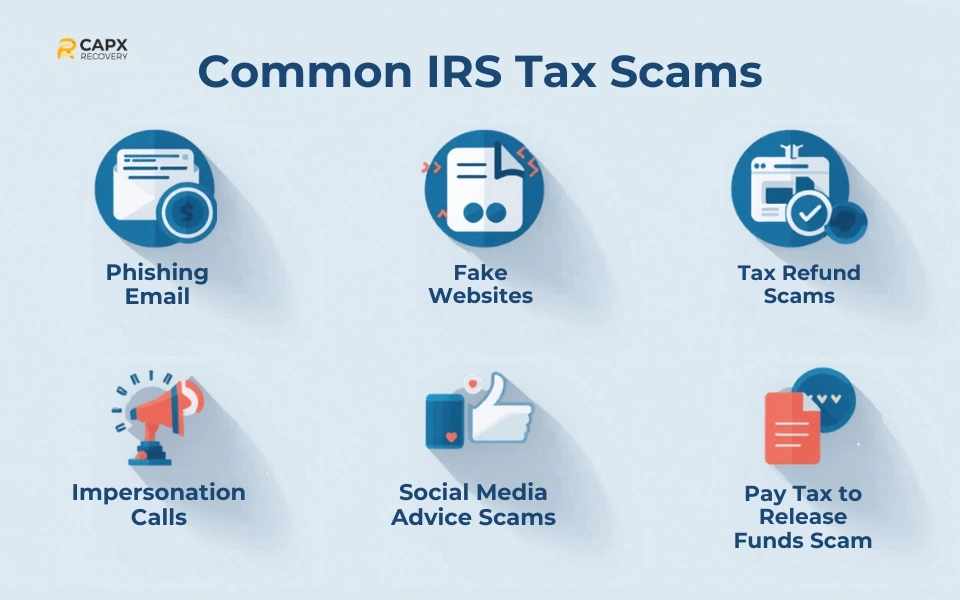
IRS tax scams show up in different forms, but they all follow the same playbook. Create urgency, sound official, and push you into a quick decision involving money or sensitive information.
Here are the most common IRS tax scams you need to watch for:
IRS Phishing Emails & Fake Websites
You receive an email saying there’s an issue with your tax return or that you’re eligible for a refund. The message looks official, often using IRS-style language and formatting.
The link takes you to a fake website designed to steal your login details, banking information, or identity data.
Red flag: The IRS does not ask you to verify sensitive information through email links.
IRS Impersonation Calls
This is one of the most common IRS impersonation scams.
You get a call claiming you owe unpaid taxes and must pay immediately to avoid penalties or legal action. The caller may sound professional and may even spoof a legitimate number.
Red flag: Any call that pressures you to act immediately or threatens consequences.
Tax Refund Scams
Instead of fear, this scam uses reward.
You’re told you qualify for a refund or special tax credit. To claim it, you’re asked to confirm your details or pay a small processing fee.
Red flag: Unexpected refund messages, especially if you didn’t initiate anything.
Ghost Tax Preparers
These scammers pose as tax professionals and offer to file your returns, often promising unusually high refunds.
They may file incorrect returns, steal your personal information, or redirect refunds to their own accounts.
Red flag: They refuse to sign your return or avoid sharing verifiable credentials.
Social Media Tax Advice Scams
You might see posts claiming the following:
- “secret IRS loopholes”
- “guaranteed refunds”
- “hidden tax credits”
These are used to push people into sharing financial details or filing false claims.
Red flag: Anything that sounds like an easy shortcut or insider trick.
“Pay Tax to Release Funds” Scam
This is one of the most damaging IRS-related scams, especially in crypto and investment cases.
You’re told your money is ready to be withdrawn, but you must first pay a tax, clearance fee, or processing charge. Once you pay, the demands either continue or access is blocked completely.
This follows the same pattern as advance fee scam tactics used in tax and investment fraud, where victims are repeatedly asked to pay upfront.
It also overlaps with fake tax and withdrawal fee scams that block access to your funds, where payments are framed as mandatory and refundable.
In many cases, this happens inside fraudulent platforms, showing how fake crypto investment platforms trap users with tax demands before cutting off access.
Red flag: Any situation where you must pay money to access your own money.
Warning Signs of an IRS Tax Scam
Most IRS tax scams follow a predictable pattern. Once you know what to look for, it becomes much easier to catch them early.
These IRS scam warning signs can help you spot fraud before any damage is done:
Urgent threats or deadlines
Messages that push you to act immediately or face penalties, arrest, or legal consequences
Pressure to make an instant payment
No time to verify, no clear explanation, just a demand to act now
Contact through calls, texts, or emails
The IRS does not randomly reach out this way for payments or sensitive issues
Requests for unusual payment methods
Gift cards, crypto, wire transfers, or prepaid cards
Suspicious links or fake websites
URLs that look slightly off or ask for confidential information
Unexpected refunds or credits
Messages claiming you’re eligible for money you didn’t request
If you notice even one of these, stop. Don’t respond. Don’t click. Don’t pay.
Take a moment to verify before doing anything else.
How the IRS Actually Contacts You
One of the easiest ways to avoid IRS tax scams is to understand how the IRS actually communicates.
In most cases, the IRS will contact you through official mail sent to your registered address. They do not start with random calls, texts, or emails demanding immediate action.
Here’s a clear comparison:
| Scam Behavior | Real IRS Behavior |
| Calls or texts you unexpectedly receive | Sends an official notice by mail first |
| Demands immediate payment | Provides time to review and respond |
| Threatens arrest or legal action instantly | Follows a formal, documented process |
| Requests payment via gift cards or crypto | Uses official government payment channels |
| Sends links to “verify” details | Directs you to official IRS procedures |
While the IRS may contact you by phone in certain cases, it usually happens after prior communication, not as the first point of contact.
If the first message you receive feels urgent, aggressive, or demands quick payment, it’s very likely part of an IRS scam.
Real-Life IRS Scam Scenarios
IRS tax scams often feel routine in the moment. That’s why people fall for them. Here’s how they typically play out in real situations.
Scenario 1: The Urgent IRS Call
You receive a call saying you have unpaid taxes, and legal action will be taken if you don’t pay immediately. The caller sounds official and may even provide a badge number or case ID.
The pressure builds quickly, and you’re pushed to act on the spot.
Scenario 2: The Tax Refund Message
You get an email or text saying you’re eligible for a refund. There’s a link to “verify your details,” and the page looks legitimate.
Once you enter your information, it’s captured and used for identity theft or further fraud.
Scenario 3: The Investment Platform Tax Trap
You’ve made profits on an investment platform and are trying to withdraw your funds. Suddenly, you’re told you need to pay a tax or clearance fee before the withdrawal can be processed.
It feels logical, especially when the amount seems small compared to your balance.
These situations often overlap with romance and investment scams that lead to tax-related payment fraud, where trust is built first, and financial demands come later.
Each of these follows the same pattern.
Create urgency. Build trust. Push for action.
Once you recognize that pattern, it becomes much easier to step back and avoid the trap.
What to Do If You’re Targeted by an IRS Scam
If you’ve been targeted by an IRS tax scam, acting quickly can reduce the damage and, in some cases, improve your chances of recovery.
Here’s what to do:
1. Stop all communication immediately
Don’t respond to calls, emails, or messages. Scammers often try to keep you engaged to apply more pressure.
2. Do not send any more money
If you’ve already made a payment, avoid sending anything further. Many IRS scams escalate with additional “fees” once you’ve paid once.
3. Report the IRS scam
Report phishing emails, impersonation calls, or fraudulent messages through official IRS reporting channels. This helps track scam activity and prevent others from being targeted.
4. Secure your accounts and personal information
Change passwords, enable two-factor authentication, and review any accounts that may have been exposed.
5. Monitor your financial activity closely
Watch your bank accounts, credit cards, and credit reports for any unusual activity in the following weeks.
In many IRS tax scams, victims are told their funds are “frozen” and can only be released after paying a fee. This connects to why scammers claim your crypto funds are frozen before demanding payment, a tactic used to keep victims paying.
If you’ve already lost money, don’t assume it’s gone for good. Taking action early can make a difference, and exploring recovery options is worth considering.
How to Protect Yourself from IRS Tax Scams
Avoiding IRS tax scams doesn’t require anything complicated. It comes down to slowing down and verifying before you act.
Here are simple ways to protect yourself:
Always verify IRS communication
If you receive any message claiming to be from the IRS, don’t respond immediately. Check through official channels before taking action.
Avoid clicking on unknown links
Emails and texts are common tools for IRS phishing scams. Even if a message looks real, go directly to the official IRS website instead of using the provided links.
Be careful with personal and financial information
Never share sensitive details like Social Security numbers, banking information, or login credentials unless you’re certain who you’re dealing with.
Work only with verified tax professionals
If you’re getting help with filing, make sure the person or service is legitimate and properly registered.
Strengthen your account security
Using strong passwords and enabling two-factor authentication can prevent small mistakes from turning into serious issues. This connects to basic account security practices to prevent financial fraud and identity theft, which play a key role in long-term protection.
Staying alert doesn’t mean overthinking everything. It just means taking a moment to verify before making any financial decision.
Latest IRS Tax Scam Trends to Watch (2026)
IRS tax scams keep evolving. What worked a few years ago has now turned into far more convincing and harder-to-detect tactics.
Here are the key trends showing up in 2026:
AI-generated IRS scam calls
Scammers are using AI to create realistic, professional-sounding voices. These calls no longer feel obviously fake, which makes them more effective.
Fake tax credits and relief programs
Messages claiming you qualify for special tax credits or government relief are being used to collect personal and financial information.
Crypto-related IRS tax scams
As crypto adoption grows, scammers are combining investment fraud with tax narratives. Victims are told to pay taxes before accessing withdrawals or profits.
Social media tax misinformation
Short-form content promoting “tax hacks” or loopholes is spreading quickly. Scammers use this confusion to push people into risky or fraudulent actions.
The methods may change, but the pattern stays the same. Scammers follow attention, trends, and behavior.
Staying aware of these shifts makes it easier to recognize IRS tax scams before they escalate.
Stay Alert and Take Action Early
IRS tax fraud does not work under complex tricks. They count on pressure, timing, and the belief that you would do something without verifying.
The following are some of the points to remember:
- The IRS does not pressure you to make instant decisions.
- Real tax processes follow a structured and documented approach
- Any request to make an immediate payment should be questioned.
Most IRS tax scams follow predictable patterns. Once you recognize them, it becomes much easier to pause, verify, and avoid making a costly mistake.
If you’ve been targeted or lost money, don’t ignore it. Acting early can make a real difference. The sooner you respond, the better your chances of limiting damage and exploring possible recovery options.Getting the right guidance early can make a real difference in protecting your finances and exploring possible recovery options with Capx Recovery.
FAQ
How can I verify if an IRS message is legitimate?
Do not trust links, numbers, or instructions provided in the message. Go directly to the official IRS website or contact them through verified channels.
What happens if I fall for an IRS tax scam?
The impact depends on what was shared. If money is sent, financial loss is possible. If personal information were exposed, there may be a risk of identity theft. Acting quickly can reduce the damage.
Can I recover money lost to an IRS scam?
Recovery depends on the payment method and how quickly action is taken. While it’s not guaranteed, exploring recovery options early improves the chances.
Are IRS tax refund messages or emails real?
Unsolicited messages about refunds are a major red flag. The IRS does not randomly send emails or texts asking you to claim or verify a refund.
Why do IRS scams ask for payment before releasing funds?
This is a common tactic used across financial fraud schemes. Victims are told to pay a tax or fee to access their money, but the payment only leads to further demands or complete loss.