
Social media has become one of the easiest ways for scammers to reach people. Not through obvious spam, but through messages, ads, comments, and profiles that look completely normal. What feels like a casual interaction can quickly turn into something else.
That’s the shift.
Social media scams don’t look like scams anymore. They look like opportunities, conversations, and relationships.
And the scale is growing. According to recent data from the U.S. Federal Trade Commission (FTC), people reported losing more than $2.1 billion to scams that started on social media in 2025, with nearly 30% of reported scam losses beginning on social platforms.
A message from a “friend.” A job offer in your inbox. An investment ad that seems too good to ignore.
The problem isn’t just that these scams exist. It’s how easily they blend into everyday online behavior. In many cases, people don’t realize what’s happening until money is involved or access is lost.
Many scams are designed to appear trustworthy at first glance, which makes them harder to recognize until it’s too late. That’s why learning how to spot a social media scam matters before responding to unknown messages, offers, or urgent requests.
This guide breaks it down clearly. How social media scams work, why they’re so effective, and what you can do to avoid getting pulled into one.
What Are Social Media Scams?
Social media scams are a type of online fraud. Scammers exploit platforms like Instagram, Facebook, TikTok, and WhatsApp to deceive individuals into sending money or sharing sensitive information.
These scams don’t rely on random outreach alone. They use the structure of social media itself, profiles, messaging, comments, and ads, to make interactions feel normal and trustworthy.
It usually starts with something simple:
- a direct message
- a follow request
- a comment
- a sponsored post
From there, the interaction builds.
The scammer may present themselves as:
- a friend or acquaintance
- a company or brand
- an investor or advisor
- someone offering an opportunity
The goal is always the same.
Create trust first, then introduce a request. That request could involve money, personal information, account access, or clicking a link that leads to a fake platform.
What makes social media scams different is how personal they feel.
You’re not dealing with a random email. You’re interacting directly with someone, which makes it harder to recognize the risk.
Why Social Media Is a Perfect Target for Scammers
Social media gives scammers exactly what they need: access, information, and trust, all in one place.
That combination makes it one of the most effective environments for fraud.
1. Direct access to people
Scammers don’t have to wait. They can message anyone instantly, comment on posts, or reach out through ads and follow requests.
2. Personal information is already available
Profiles often reveal names, photos, interests, locations, and connections. This makes it easier to craft messages that feel relevant and believable.
3. Built-in trust through profiles
A profile with photos, followers, and activity looks real. Even fake accounts can appear legitimate at first glance.
4. Mass targeting at scale
Scammers can contact hundreds or thousands of people at once. They don’t need everyone to respond, just a few.
5. Blending into normal behavior
Everything happens in a familiar environment. Messaging, liking, commenting, and sharing are everyday actions, which makes it harder to spot when something is off.
6. Scammers don’t need to chase victims anymore.
They operate where people already are, and social media gives them the perfect setup to do it.
Most Common Types of Social Media Scams
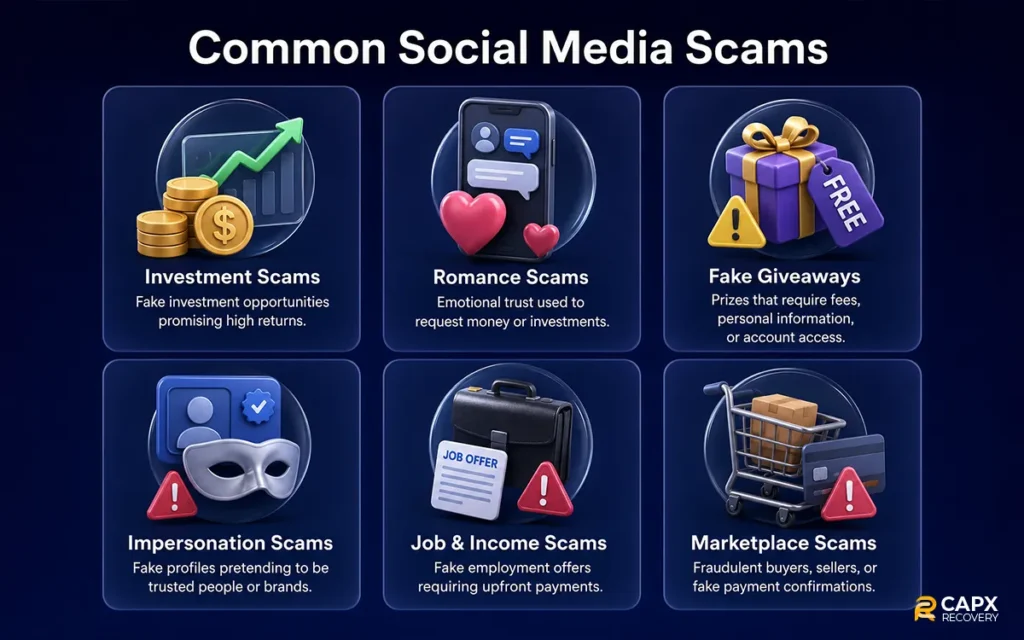
Social media scams show up in different forms, but most follow familiar patterns. Once you recognize them, it becomes much easier to spot what’s really happening.
Here are the most common types:
1. Investment Scams
You’re introduced to a trading or crypto opportunity promising unusually high returns. The platform looks legitimate, profits appear quickly, and you’re encouraged to invest more money over time.
For example, someone may message you after joining an investment group or seeing your comment online, claiming they made huge profits through a “trusted” crypto platform. At first, small withdrawals may work to build trust. But when you try withdrawing larger amounts, unexpected taxes, verification fees, or account restrictions suddenly appear.
These scams often follow patterns seen in fake crypto investment platforms, where victims are pressured into repeated payments before losing access to funds.
2. Romance Scams
A connection builds gradually through messages, often over weeks or months. The conversations feel personal, trust develops, and eventually, financial requests begin.
For example, someone you met through Instagram or Facebook may claim they’re traveling, dealing with an emergency, or struggling to access money temporarily. In some cases, the relationship shifts into crypto investments, where victims are encouraged to invest together.
Many of these situations overlap with romance and dating scams, where emotional trust is used to lower suspicion.
3. Fake Giveaways and Prizes
You’re told you’ve won a prize, exclusive reward, or giveaway. It might look like it came from a well-known brand, creator, or influencer account.
For example, you receive a message saying you’ve won a new smartphone or cash reward, but first you must pay “shipping fees,” verify your identity, or click a suspicious link to claim it.
The goal is usually to steal payment details, account access, or personal information.
4. Impersonation Scams
Scammers pretend to be someone familiar, a friend, influencer, company representative, or trusted brand. Fake profiles are designed to look convincing enough that you don’t question them immediately.
For example, a cloned social media account of a friend messages asking for urgent financial help, or a fake customer support profile reaches out after you post about a problem online.
These scams rely heavily on trust and social engineering tactics to pressure quick decisions.
5. Job and Income Scams
You’re offered a remote job, freelance project, or easy side-income opportunity. The offer sounds flexible, high-paying, and often arrives unexpectedly through direct messages.
For example, someone claims they’re hiring for a remote assistant role but asks you to pay for onboarding, software access, or identity verification before starting.
These scams are increasingly common on professional platforms and messaging apps, especially through fake recruiter profiles and LinkedIn scams.
6. Marketplace Scams
You buy or sell products through social platforms, but something goes wrong. The payment disappears, the product never arrives, or fake proof of payment is used to pressure shipment.
For example, a buyer sends a fake payment confirmation for an item you’re selling, claiming the money is “processing” while urging you to ship immediately.
How Social Media Scams Work (Step-by-Step)
Most social media scams follow a repeatable flow. The details may change, but the structure is consistent.
Here’s how it usually happens:
1. Initial Contact
It starts with a message, comment, follow request, or ad. The interaction feels normal and non-threatening.
2. Trust Building
The scammer creates familiarity. They may act friendly, professional, or helpful. In some cases, they pretend to be someone you know.
3. Emotional or Financial Hook
You’re presented with something that requires attention:
- an opportunity
- a problem
- a reward
- a situation that feels urgent or important
4. Urgency is Introduced
You’re pushed to act quickly. Limited-time offers, emergencies, or deadlines are used to reduce hesitation.
5. Request for Money or Information
You’re asked to send money, share personal details, or click a link.
6. Repeated Demands or Disappearance
Once you act, either more requests follow or the scammer disappears.
This is the same structure seen in advance fee scam tactics used in financial and investment fraud, where victims are pushed into making payments before realizing what’s happening.
Real Examples of Social Media Scams
Social media scams often feel abstract until you see how they play out in real situations. These examples show how easily everyday interactions can turn into fraud.
1. Fake Crypto Investment Ad
You see an ad promising high returns through a trading platform. The website looks professional, and early profits appear in your account. When you try to withdraw, you’re asked to pay fees or taxes first.
2. Impersonated Friend Asking for Help
You get a message from someone who looks like a friend or acquaintance. They say they’re in trouble and need money urgently. The tone feels real, so it’s easy to respond without verifying.
3. Influencer Giveaway Scam
A verified-looking account announces a giveaway. You’re asked to send a small fee or share details to claim your prize. The account may have followers and engagement, making it seem legitimate.
4. Fake Job Offer Through DM
You receive a message offering a remote job or side income opportunity. Before starting, you’re asked to pay for training, tools, or account setup.
Each of these situations follows the same pattern. A normal interaction turns into a financial request.
That’s what makes social media scams effective. They don’t feel like scams until it’s too late.
Red Flags to Watch For
Social media fraud is not usually evident in the beginning, but they drop hints along the way. The trick is to observe such indicators before the situation progresses.
In most of the scenarios, it starts with unforeseen contact. A message or request to follow or comment from a person that you do not know, or someone who looks familiar but feels a bit off. The first contact is made to be natural, which is why you do not question.
Some trends are likely to emerge as the discussion continues:
- The sense of urgency or necessity to do something fast is usually associated with a time limit, an emergency, or a scarcity of time.
- Too good to be true offers, in the form of guaranteed returns, easy money, or surprising benefits.
- Money or sensitive information requests, occasionally disguised as assistance, a check, or an investment.
- Hyperlinks to sites that look valid, but are a little out of place in terms of design or address.
The other crucial indicator is the behavior of the profile. You may observe a lack of activity, newly made accounts, or inconsistent information that does not completely correspond to the narrative being shared.
We may also, in certain instances, request you to change the discussion to a different platform, such as WhatsApp or Telegram, that minimizes visibility and renders it more difficult to report.
All these are indications that do not necessarily mean a scam, but when they begin to manifest, then it is a good sign that something is wrong.
Why People Fall for Social Media Scams
Social media scams don’t work because people are careless. They work because they’re built around how people naturally think and interact online.
A big factor is trust. When a message comes through a familiar platform, or from a profile that looks real, it doesn’t immediately feel risky. The environment itself lowers suspicion.
There’s also speed. Social media is designed for quick interactions, quick replies, and quick decisions. Scammers use that pace to their advantage, pushing you to act before you take a step back.
Then come emotional and psychological triggers. This could be excitement from an opportunity, fear from an urgent situation, or curiosity from something unexpected. These reactions often override careful thinking.
Finally, there’s familiarity. When something looks like a normal message, a job offer, a giveaway, or even a conversation, it blends into everyday behavior.
That’s what makes these scams effective. They don’t feel like a threat. They feel like something you’ve seen before.
What to Do If You’re Targeted
When you think you are the victim of a social media scam, the best thing to do is to take control of the situation by first slowing down. Doing it fast might only increase the harm, but doing it right early is what will help to contain the harm.
Start by stopping all communication. As soon as you realize that something is wrong, do not proceed with the conversation. Fraudsters count on keeping you entertained so that they can exert further pressure.
Then, do not send any money or information. Don’t do it, even though the request might sound petite or urgent. Most frauds start off with a low amount and proceed to get bigger.
At that, concentrate on locking down your accounts and recording the events:
- Change your passwords and turn on two-factor authentication.
- Check your accounts for any suspicious activity.
- Copy all evidence, such as messages, links, profiles, and transaction details.
Also, it is necessary to report the account using the platform so that other people are less likely to be targeted.
When money has been dispatched, then early action can pay off. A great deal of them proceed along the lines of the bogus tax and withdrawal fee schemes, which deny you your money, and any stalling will merely increase the problems.
Doing this will keep you in control, and you will not have to worry about the situation worsening.
If you’ve been affected by a social media scam, the situation can feel unclear and overwhelming. This is where Capx Recovery helps bring structure and direction. The focus is not just on identifying what happened but on helping you take the right steps forward.
How Capx Recovery Helps

Process typically begins with a detailed case review, where your situation is assessed based on conversations, payment requests, and platform activity. This helps determine how the scam was carried out.
From there, the next step is evidence collection, including:
- chat history
- transaction records
- screenshots
- profile details
This creates a clear and organized record of the incident.
Once the details are in place, Capx Recovery works on scam pattern analysis. Social media scams often follow repeatable structures, and identifying these patterns helps confirm the nature of the fraud.
It is on the basis of this that you are advised on what to do next, such as what to do to secure your accounts and financial exposure and what to do to see potential recovery options.
You are also assisted in the process to prevent additional risks or fake scams.
The purpose of social media scams is to cause confusion and urgency.
Making it structured will assist you in looking back, comprehending what has occurred, and proceeding with something clear.
How to Stay Safe Going Forward
After learning the tricks of social media scams, the next thing is to develop habits that will mitigate the risk in the long run. It is not about not using social media, but a more conscious use.
Begin with your interaction. Be careful of those with whom you interact and what you post. To sound personal and believable, scammers usually base their approach on publicly available information.
Some small ways can go a long way:
- Keep personal information on your profile limited, particularly that which can be utilized to create trust.
- Care about unfamiliar relationships, even when it seems that the profile is real.
- Do not follow links in messages; go to official websites.
- Use a password that is difficult to crack and two-factor authentication to secure your accounts.
It also aids in taking time to reflect on an action. The majority of fraudsters play on urgency, and thus a pause is an added advantage.
Being safe does not mean that one should become suspicious of everyone. It is the process of taking time to make a better decision.
Be Watchful and Act Quickly
Social media tricks are designed to be inconspicuous. They do not appear as blatant threats; they resemble ordinary interactions, opportunities, and conversations.
That’s what makes them effective.
However, after you know the pattern, unforeseen contact, immediate trust, urgency, and financial requests, it is much easier to notice what is going on.
When something does not work, it should not be disregarded. Before making any decision, take time to stop, check, and back off.
Provided you have been targeted or lost money, moving fast can make a difference. The more time you have to wait, the more difficult it is to do something significant.
Early right direction assists in keeping things under control. Capx Recovery can assist you in determining the situation, understanding the scam, and taking the correct action to protect your finances, and discussing the possible way of recovery.
FAQs
How do scammers find targets on social media?
They use public profiles, ads, hashtags, and mass messaging to reach people. Many scams start with unsolicited messages or follow-up requests.
How can you tell if a social media profile is fake?
Look for signs like low activity, recently created accounts, inconsistent details, or duplicate profiles pretending to be someone else.
Is it safe to click links sent through messages?
No. Avoid clicking links from unknown or unverified sources. Always go directly to official websites instead.
Can you recover money lost to a social media scam?
Recovery depends on how the payment was made and how quickly action is taken. Acting early improves the chances.
What should you do immediately after spotting a scam?
Stop communication, avoid sending money, secure your accounts, report the profile, and save all evidence.