

Table of Contents
Fake crypto exchange websites steal funds by copying real trading platforms, pushing people to deposit, and showing fake profits. When you try to withdraw, the site blocks you or demands extra fees for tax, verification, or unlocking. The money never sits on the platform. Scammers move it through wallets they control.
What to do right now:
- Stop sending money. Do not pay any release fee.
- Save the website address, wallet addresses, transaction IDs, and chat logs.
- Do not delete the app or your messages yet.
- Secure your email, exchange, and wallet accounts.
- Report the scam, then read the recovery section below.
If a platform will not let you withdraw, take a breath. You are not alone. These sites are built by organized teams who do this for a living. This guide shows how the scam works, how to spot it, and what realistic options you have.
How Do Fake Crypto Exchange Scams Work?
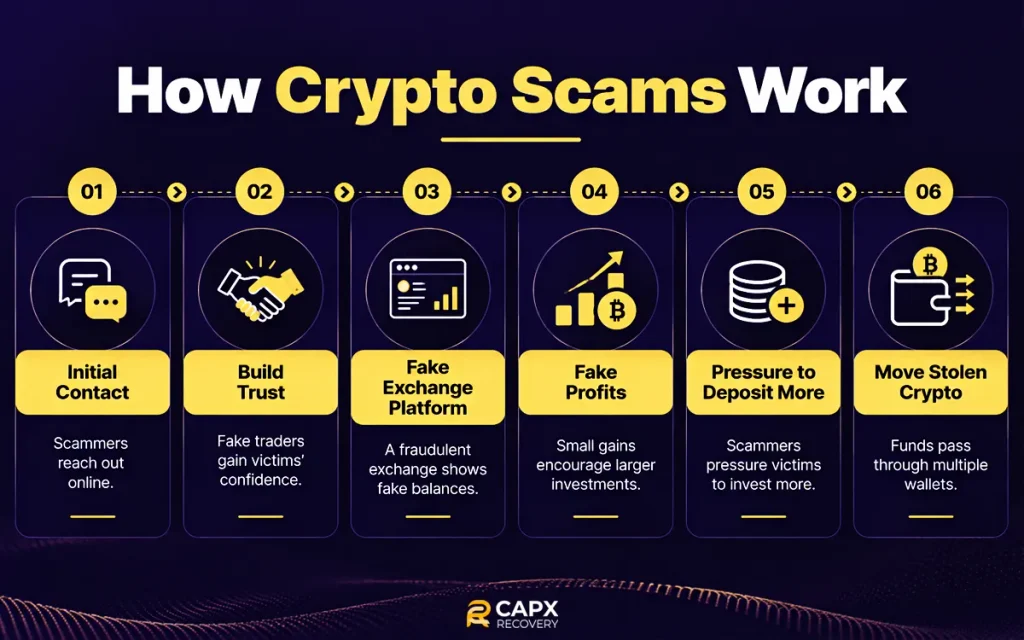
Fake crypto exchange scams use fraudulent trading platforms, fake profits, and false withdrawal promises to convince victims to deposit cryptocurrency. Scammers build trust, pressure users to invest more, and often demand additional fees when victims try to withdraw their funds.
1. Initial Contact
A scammer reaches out through social media, a dating app, Telegram, or WhatsApp. The conversation may begin with an advertisement or a fake support agent responding to a question in a public group. Read our guide to common telegram scams to understand how these interactions typically start.
2. Building Trust
The scammer poses as a friend, mentor, or successful trader to gain the victim’s confidence. According to Group-IB research, these operations may involve fake investors and support staff who create the illusion of a legitimate trading community.
3. Access to a Fake Trading Platform
The victim receives a link to a website or app designed to resemble a legitimate cryptocurrency exchange. Some platforms require an invitation code, making access more controlled and connecting the victim’s account to the person who introduced them.
4. Initial Deposit and Displayed Profits
The victim makes a small deposit, and the platform displays apparent trading gains. In some cases, scammers allow a small withdrawal to make the platform seem legitimate and encourage further investment.
5. Increasing Investment Pressure
Once trust is established, the scammer encourages the victim to deposit more money. Promises of exclusive opportunities, time-limited offers, or larger profits create urgency and make it harder for victims to step away.
6. Withdrawal Restrictions and Additional Fees
When the victim attempts to withdraw funds, the platform demands additional payments for supposed taxes, verification, liquidity, or account unlocking. These demands are common warning signs of a crypto investment scam. Paying the requested amount may lead to further demands rather than releasing the funds.
7. Movement of Stolen Funds
After receiving the victim’s cryptocurrency, the scammers may move it through multiple wallets, cross-chain bridges, decentralized exchanges, mixers, or deposit addresses at other exchanges. These transfers can complicate transaction tracing and make it harder to identify where the funds went.
The balance you see on screen is just a number in a database. It is not your money sitting safely in an account. Your real deposit went to the scammer the moment you sent it.
What Types of Fake Crypto Exchange Scams Are There?
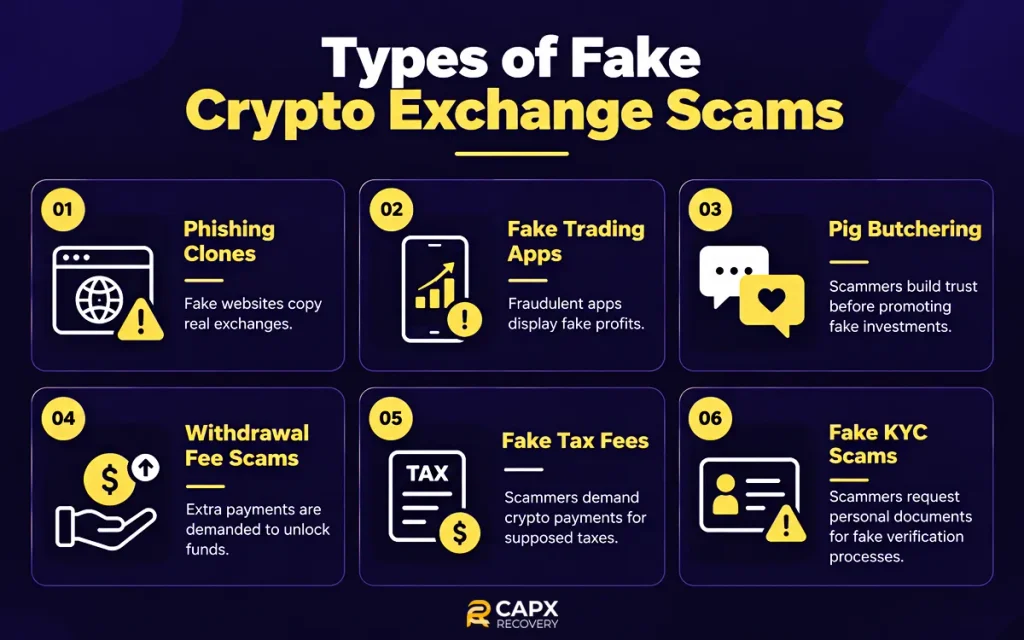
The scam wears different outfits, but the goal is always the same. Here are the main versions.
1. Phishing exchange clones
These sites copy a real exchange. The web address is often one letter off. You type your login, and the scammer collects it, or you deposit funds straight to their wallet.
2. Fake trading apps
Some scams use apps that are not on the official app stores. You are told to install them from a link. The trades and profits inside are made up.
3. Pig butchering crypto scams
This is a long con. The scammer builds a friendship or romance for weeks, then introduces an investment platform. The name comes from the idea of fattening up the victim with trust and fake gains before the loss. A pig butchering crypto scam almost always ends on a fake trading platform.
4. Withdrawal fee scams
You are told to pay a fee to release your money. It is the same scam in a different hat, and the fees keep coming.
5. Crypto tax or clearance fee scams
The platform claims you must pay taxes or clearance fees before withdrawing your funds. Legitimate taxes are handled through the relevant tax authority, not by sending cryptocurrency to a platform agent. Learn more about crypto tax scam recovery if you’ve encountered this type of fraud.
6. Fake KYC and account freeze scams
Scammers may collect your identity documents, freeze your account, and demand payment to restore access to your crypto funds. Your personal information could also be misused for further fraud. If you’re dealing with a frozen crypto wallet, it’s important to understand the possible causes and take steps to protect your funds and personal information.
7. Malicious browser extensions and wallet-connected apps
A fake site asks you to connect your wallet and sign a message. Signing is not the same as logging in. A single approval can let a scammer drain tokens from your wallet.
How Can You Tell If a Crypto Exchange Is Fake?
Look for these warning signs before you deposit anything. One red flag is a reason to pause. Several together mean walk away.
Red flag checklist
- A lookalike web address or odd spelling
- Guaranteed or very high returns
- Someone you do not know contacted you first
- Pressure to deposit quickly
- You can see a balance but cannot withdraw it
- Repeated fees before release
- No company name, license, or address you can verify
- Copied design, fake reviews, or fake celebrity endorsements
- Requests for your seed phrase, remote access to your device, or API keys
Never share your seed phrase with anyone. No real exchange or support agent needs it.
Legitimate exchange vs. fake exchange
| Signal | Legitimate exchange | Fake exchange |
| How you found it | You searched for it or used the official app store listing | A stranger, ad, or chat sent you the link |
| Web address | Matches the official domain you can confirm elsewhere | Lookalike spelling, new domain, odd ending |
| Company and regulation | Named company, registration you can check with a regulator | Vague or copied details that do not check out |
| Returns | No guarantees | Guaranteed or unusually high profits |
| Withdrawals | You can withdraw your own balance, and network fees come out of the amount | Extra fees or taxes must be paid first |
| Support | Official channels with ticket history | Personal chat accounts that change often |
| Sign up | Open to anyone | Invite code or chat screening required |
| Security requests | Never asks for your seed phrase | Asks for seed phrase, remote access, or API keys |
Withdrawal scam red flags
If a site stops you from withdrawing, the reason it gives tells you a lot.
| What the site says | Why it is a trap | What to do |
| Pay a tax before you withdraw | Real tax is not paid to an exchange agent to unlock your balance | Stop. Do not pay. Save the message |
| Pay a verification or insurance fee | It creates a fee loop with no end | Stop. Screenshot the request |
| Deposit more to meet a minimum | It raises the amount you lose | Stop all deposits |
| Your account is frozen for a violation | A pressure tactic meant to cause panic | Do not send money. Gather evidence |
| Pay a liquidity or unlock fee | An invented cost for a service that does not exist | Stop. Report it |
| Only VIP accounts can withdraw | A fake status ladder to get you to deposit more | Stop. Do not upgrade |
What Do the Numbers Say About Crypto Scams in 2026?
These scams are not rare. The data shows how big the problem is.
The FBI IC3 2025 Annual Report logged 181,565 crypto related complaints and $11.366 billion in reported losses. Crypto investment fraud was the largest loss category at about $7.2 billion. In plain English, crypto scams cost Americans more than almost any other internet crime, and those are only the cases people reported.
The Chainalysis 2026 Crypto Crime Report found that at least $14 billion flowed to scams on-chain in 2025. The firm says the total could pass $17 billion as more scam wallets get identified. That means the first count is usually too low.
Group-IB research on fake investment platforms shows why these sites look so polished. They are run by organized teams with different jobs, from finding targets to building sites to handling money. You are up against a business, not one person.
What Should You Do If You Used a Fake Crypto Exchange?
If you used a fake crypto exchange, act quickly to protect your remaining funds, secure your accounts, and preserve transaction records. Follow these steps to report the scam, trace fund movements, and understand your options for potential recovery.
1. Stop Sending Money
Do not pay additional fees to unlock withdrawals or release funds from a suspicious trading platform. Requests for taxes, verification charges, or account unlocking fees may be part of the scam.
2. Preserve All Evidence
Save screenshots of the website, transaction IDs, receiving wallet addresses, chat messages, emails, and payment records. Record the dates and amounts involved, and preserve the evidence before deleting messages or closing accounts.
3. Revoke Wallet Permissions
If you connected a crypto wallet to the suspicious platform, review and revoke any unnecessary wallet connections and token approvals. This can help prevent further unauthorized transactions, although revoking permissions cannot recover funds already transferred.
4. Secure Your Accounts
Change passwords for your email, exchange, and other affected accounts. Enable two-factor authentication and move any remaining assets to a secure wallet if you suspect the existing wallet has been compromised. Never share your seed phrase or private keys.
5. Report the Fraud
Submit a report to the relevant authorities, such as the FBI’s Internet Crime Complaint Center (IC3), the CFTC, the SEC, or the FTC in the United States. Contact the bank or cryptocurrency exchange involved in the transfers. Victims outside the US should report the incident to their national cybercrime authority.
6. Request a Blockchain Tracing Review
A blockchain tracing review examines transaction records to identify how cryptocurrency moved between wallets and platforms. The findings may help support a fraud complaint or investigation. Transaction tracing can provide useful evidence, but it cannot guarantee that stolen cryptocurrency will be recovered. Learn more about how the blockchain tracing process works.
Can You Recover Money From a Fake Crypto Exchange?
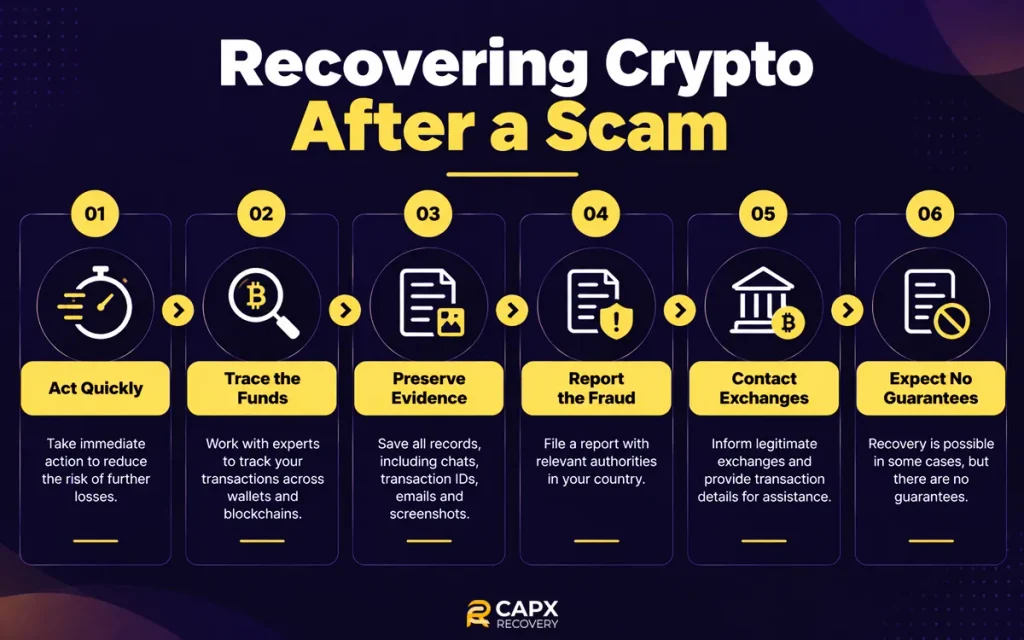
Sometimes, in part, and never with a guarantee. Results depend on how fast you act and where the money went.
Here is what affects your chances:
1. Speed of Reporting
Reporting the scam quickly gives investigators a better opportunity to trace transactions and identify where the funds have moved. Delays can reduce the chances of taking timely action.
2. Traceability of Cryptocurrency
Many blockchains maintain publicly accessible transaction records, allowing investigators to follow fund movements between wallet addresses. However, tracing transactions does not automatically identify the people behind them or guarantee recovery.
3. Exchange Cooperation
If stolen funds reach a regulated cryptocurrency exchange, the platform may be able to restrict access to them after receiving a valid request from the appropriate authorities. The outcome depends on the exchange’s policies, available evidence, and applicable laws.
4. Quality of Evidence
Complete records help investigators understand how the scam occurred and track the movement of funds. Transaction IDs, wallet addresses, payment receipts, chat screenshots, and platform details can support the investigation.
5. Jurisdiction and Legal Requirements
Cross-border cases can take longer because they may involve multiple countries, different legal systems, and separate law enforcement agencies. Cooperation between the relevant authorities can influence how quickly a case progresses.
6. Use of Mixers and Privacy Tools
Scammers may use cryptocurrency mixers, privacy-focused services, or complex transaction routes to obscure the movement of funds. These methods can make tracing more difficult, although the level of difficulty depends on the tools used and the available transaction evidence.
Beware of recovery scams
Be careful here. Scammers know victims want their money back, so they target the same people twice. The IC3 report counts 10,516 complaints about recovery scams, with about $1.4 billion in losses. These scammers pose as lawyers, officials, or recovery experts.
Warning signs of a fake recovery service:
- It guarantees you will get your money back
- It asks for a large upfront fee and pushes you to pay fast
- It asks for your seed phrase or remote access to your device
- It contacted you first after you posted about your loss
- It has no verifiable company details
Ask any service, including us, what it will actually deliver and what it cannot promise. A trustworthy firm will tell you plainly.
How Capx Recovery Can Help

Capx Recovery provides case analysis, blockchain tracing, and recovery guidance. We cannot promise to recover your funds, and no honest firm can. What we can do is help you understand what happened and what your options are.
Here is what the process includes:
- Case review. We look at what happened and what evidence you have.
- Transaction and blockchain tracing. We follow the movement of your funds where that is possible.
- Structured evidence report. You get a clear record you can use with banks, exchanges, and authorities.
- Guidance on complaints and next steps. We explain what to file and where.
You can learn more about our approach to crypto investment scam recovery. If the scam started in a chat or on a social app, see our social media scam recovery service. Recovery may be possible in some cases. It depends on the facts of each case, and it is not guaranteed.
FAQ
How can I tell if a crypto exchange is fake?
Check for a lookalike web address, guaranteed profits, and a stranger who contacted you first. Also watch for missing company details and fees demanded before you can withdraw.
Why can I see profits but cannot withdraw?
The profit is just a number on a screen. The platform is built to display gains and block cash outs. Your deposit was never invested.
Are crypto withdrawal fees scams?
Normal network fees come out of your withdrawal amount. A separate tax, unlock, or verification fee that you must pay before you can withdraw your own balance is a sign of a scam.
Can stolen crypto be traced?
Often, yes, because many blockchains are public. Tracing shows where funds moved. It does not mean the funds can be pulled back.
Can I recover crypto lost to a fake exchange?
Possibly in some cases, but never with a guarantee. Speed, evidence quality, and where the funds ended up matter most.
Where do I report a fake crypto exchange?
Report to the FBI IC3, the CFTC, the SEC, your state regulator, and the FTC. Also tell the exchange or bank involved. Outside the US, contact your national cybercrime authority.
What evidence should I save after a crypto scam?
Save the website address, wallet addresses, transaction IDs, screenshots, chat logs, emails, and payment records. Add dates and amounts.